


Introduction: A Strange Trip for Rates So Far in 2026
“I am completely operational, and all my circuits are functioning perfectly.”
Year-ahead consensus predictions rarely get things perfectly right, but it’s fair to say that despite looking very promising for the first two months of the year, the consensus call for lower interest rates looks like a particularly bad one. The 10-year U.S. Treasury yield has risen sharply against expectations it would fall. And instead of further trimming its policy rate, the Federal Reserve may shortly begin hiking again. The effects of this “miss” are all around us: a flatter yield curve, a frustrating lack of progress in the housing market recovery, and a further souring of consumers’ moods, to name just a few.
Interest rates’ winding journey in 2026 calls to mind The Odyssey, the latest film adaptation of which is shattering box office records this summer. But for the inspiration behind this week’s Edge, we reach back all the way to 1968 to a very different Odyssey: Stanley Kubrick’s landmark science fiction classic, 2001: A Space Odyssey.
While we’re not writing about AI this week, 2001’s major theme, whether technological innovation can or should eliminate human decision making (and error), is central to the reforms happening at the Fed this year. Changes to a central bank’s framework and communication have great implications for investors. These reforms, as they are put into place, may drive more of the type of bond market volatility that occurred last week. This could leave long-term interest rates higher and contribute to slower growth in the rate-sensitive parts of the economy for now.
What Did We Learn from the July Fed Meeting?
“I’m sorry, I’m simply not at liberty to say.”
Coming into last Wednesday’s Federal Open Market Committee (FOMC) meeting, investors were putting the odds of a rate increase at roughly one in three. That may not sound like much, but one can count on one hand the number of Fed meetings in the past twenty years whose outcomes were so uncertain going into the meeting. The evolution of investor expectations for Fed policy – from multiple cuts to at least some chance of a hike by July – illustrates the interest rate Odyssey of 2026:
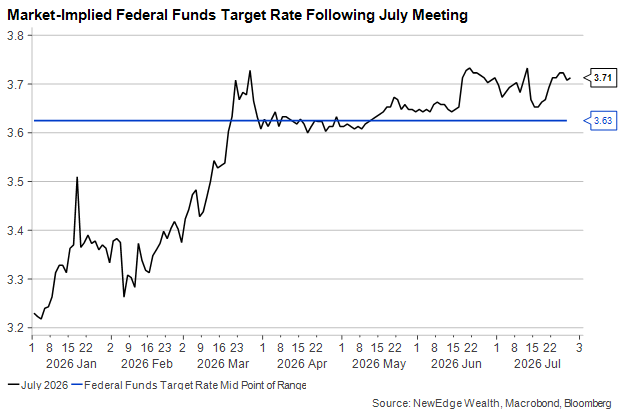
As of 7/29/26 (Just Before 2pm EST)
As it turned out, the Fed did not raise rates. Notably, three of the twelve FOMC voting members dissented from that decision, favoring an immediate increase. But the market-implied odds of a hike by the next meeting fell from over 100% to below 60% the morning after the decision.
In his comments following the meeting, Chair Warsh did not share many thoughts on the economy or policy outlook beyond what was in the committee’s brief and unchanged statement. The most interesting part of the press conference was Warsh’s repeated mentions of the rise in real interest rates (among other market moves) since the last meeting as, perhaps, one reason the committee did not feel it needed to adjust policy. We’ll cover that in some depth below.
The Case for Hiking vs. The Case for Waiting
“This mission is too important for me to allow you to jeopardize it.”
The September FOMC meeting is only a few weeks away, and despite a lack of guidance for Chair Warsh or the FOMC statement, markets continue to suggest that a hike is more likely than not. The best case for hiking rates is that inflation has been too high for too long. Indeed, core PCE inflation has been above the Fed’s 2% target since March 2021. Even the new Chairman, who has been reluctant to say much of anything about the economy to this point, has made it clear that the Fed is fixated on bringing inflation down.
While energy-related inflation has been responsible for the bulk of new price pressures this year, proponents of higher rates cite other less transitory drivers such as continued wage pressures and A.I. production bottlenecks as reasons to hike. Indeed, core services inflation excluding housing (often referred to as “Supercore” for its stickiness and lagged response to tighter policy) remains well above even its highest level from the pre-COVID years:
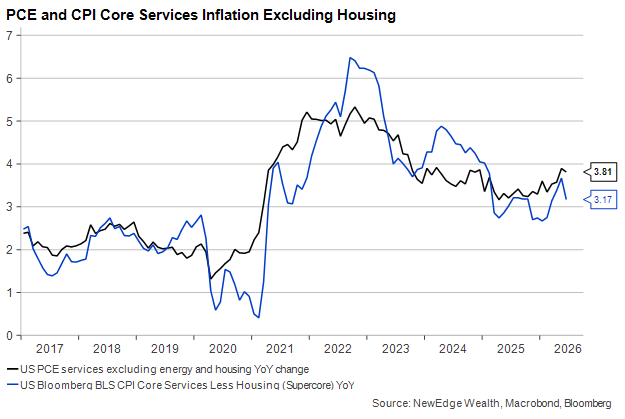
As of 7/30/26
Core services inflation is often connected to the labor market because of its close connection to wage growth. While nothing in the labor market currently screams “overheating”, nothing in Aggregate Weekly Payrolls (a series that encompasses changes in the number of workers, their hours, and their wages) suggests that slightly higher interest rates will drive significant further slowing in the labor market:
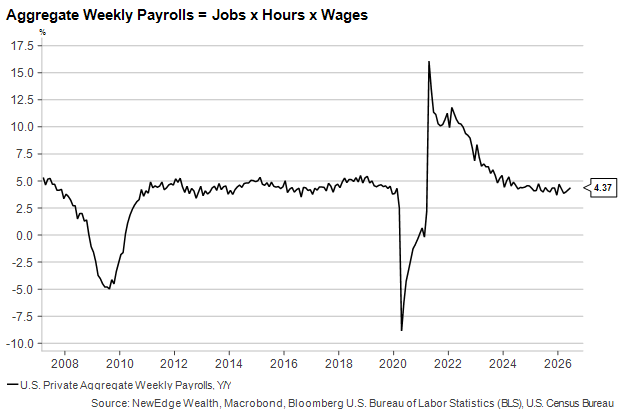
As of 7/30/26
With inflation above target and unemployment barely above 4%, it’s a hard time to be a dove on the FOMC. The argument against raising rates begins with the fact that the cumulative tightening of 2022-23 is still wreaking havoc on rate-sensitive parts of the economy like the housing market. Mortgage rates just hit their highest level in a year, and mortgage applications for purchase are still barely half of what they were in the late 2010s, let alone in the post-COVID boom years:
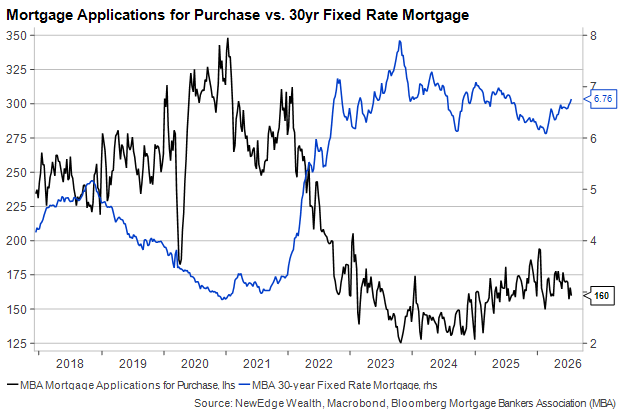
As of 7/30/26
Of course, as we saw last week, long-term rates can also rise when the Fed is perceived as too dovish, i.e., not committed enough to fighting inflation. This makes the doves’ argument a little trickier, as they must not only advocate against rate hikes but also have a clear “theory of the case” for why inflation will come down from here on its own.
Second, while unemployment remains low and wage growth remains solid, as we pointed out above, there has been a clear softening in the labor market since the unexpectedly strong start to the year
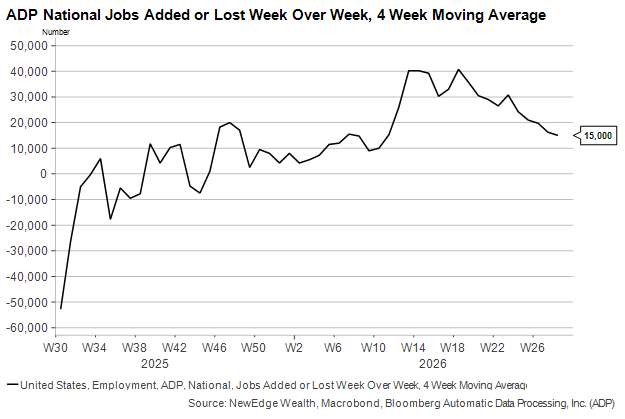
As of 7/30/26
Third, this year’s inflationary shock has come primarily from energy supply shortages, not a surge in overall demand. As a result, wage growth after inflation has fallen to essentially zero. This has historically not been an environment that calls for tighter monetary policy, as the dark bars indicating recessions on the graph below show:
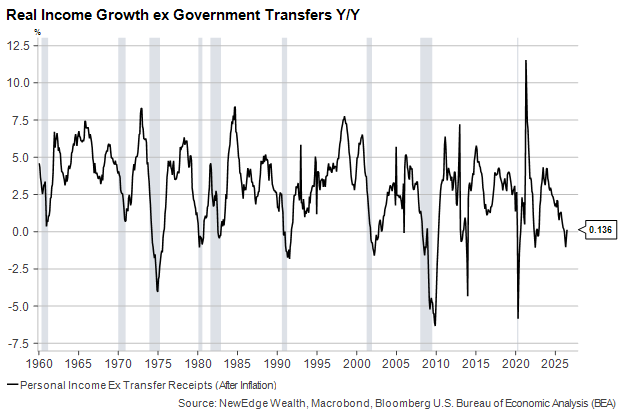
As of 7/30/26
To be candid, the questions of whether the Fed should hike or will hike over the next several months are hard to answer. Warsh and company will have another six weeks of economic data to consider before their next meeting. Soft core inflation prints like the one we just got for June could keep the hawks at bay, while unexpectedly strong consumer or manufacturing data could make it harder for the doves to advocate more patience. If forced to make a call, we would say that the major data in the coming months should marginally weaken the case for a hike at the next meeting, supporting a “hold” stance from the Fed.
What is the Bond Market Telling Us?
“It can only be attributable to human error.”
Of course, the Fed is not the sole arbiter of whether monetary policy is too loose or too tight. The bond market has its say, as well, and often does wait to hear from central banks before it chimes in with its own view. Consider the yields on long-dated, inflation-protected Treasuries (TIPS):
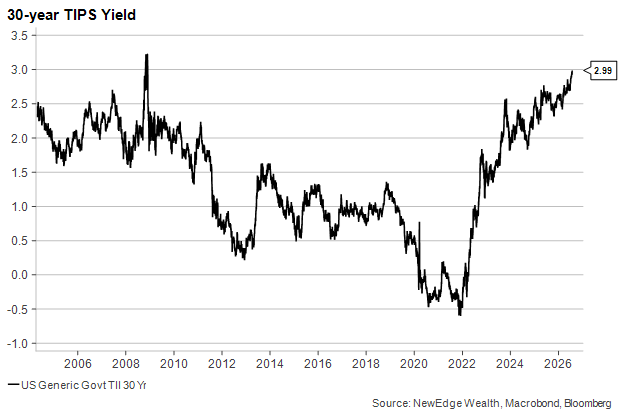
As of 7/30/26
The sharp rise in long-dated real yields since 2021 has coincided with the end of zero interest rate policy and a shrinking Fed balance sheet. Together, these represent a significant tightening of financial conditions, one that has continued through the month of July with the 30-year TIPS yield approaching its highest level ever. Higher real yields reflect investors’ collective view that bonds must offer higher returns to compete with other assets, but they also weaken growth in home borrowing and capital spending.
It’s likely that Warsh and the other eight members of the FOMC majority last week felt rising yields had given them some cover to delay tightening policy. In other words, the market had already done some of their work for them, “playing the ball instead of the referee”, as he put it. This approach may work provided rates continue to move in the direction the Fed prefers. But it’s also likely to lead to more volatility than would otherwise be the case as markets overreact to data to get the Fed’s attention. Long-term rates are, in part, a reflection of the market’s expectation for short-term rates. And the level of short-term rates remains solely at the Fed’s discretion.
For further evidence of tightening in the bond market, we can look at the slope of the Treasury yield curve. After steepening for almost two years, the curve has flattened this year on increased expectations for Fed hikes and marginally less optimism about economic growth. A flattening yield curve is a sign that monetary policy is restricting growth and financial activity. Until it infamously registered a “false positive” in 2022, an inverted curve had been a very reliable forecaster of recessions.
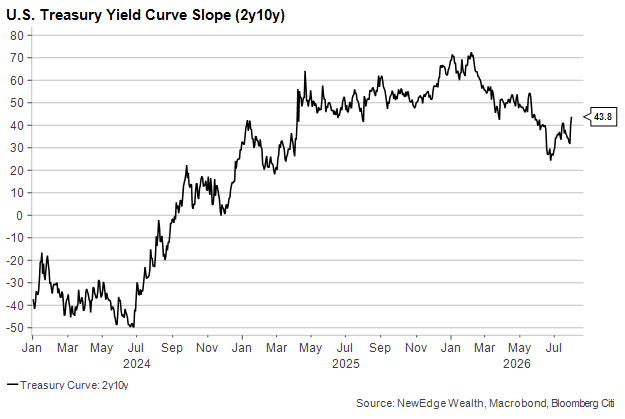
As of 7/30/26
The messy market reaction to the Fed meeting requires this quick aside: As the graph above shows, the yield curve steepened immediately following the latest FOMC meeting, specifically following Chair Warsh’s comments about allowing markets to follow the data without considering how the Fed might react. He also hinted at a potential change to the Fed’s inflation framework next year, which could weaken the credibility of the current 2% PCE inflation target. The curve underwent a “Zoo Steepening”: short rates fell on dovish hopes while long rates rose on credibility concerns, i.e., bulls and bears pulled in opposite directions. Historically, this is a sign a central bank is risking losing its credibility and it bears (forgive the pun) close watching.
The Fed has seen its credibility waver before, but it has been nearly 50 years since Chair Arthur Burns lost it completely. Last week’s volatility aside, we remain more concerned about the effects of monetary tightening, whether intentional by the Fed or not, than we are about the risks the Fed will let inflation get out of control.
Moreover, Treasuries are not the only financial assets showing the effects of tighter financial conditions. Stock valuations have fallen (mainly for reasons other than monetary policy, it must be said), and corporate credit spreads have crept up from their lows. Markets do not seem concerned about severe or imminent economic slowing, but they are gently reminding us that regardless of what the twelve FOMC voters decide over the balance of the year, markets get a vote, as well.
Conclusion: Getting Used to The New Normal
“I know I’ve made some very poor decisions recently, but I can give you my complete assurance that my work will be back to normal.”
The era of radical Fed transparency is clearly over. The regime that has replaced it has yet to make any concrete policy changes or even an indication as to when or why future changes might occur. This puts markets firmly in the driver’s seat, which Chair Warsh seems to prefer.
One lesson of 2026 is that Fed policy is not always the primary drivers of interest rates at any given moment. For the time being, the global economy and financial markets (including bond markets) remain hostage to developments in the Middle East and the knock-on effects of an impaired global oil supply. Over the long run, the data will tell us whether policy is too loose or too tight, and the uncertainty about the Fed’s plans for interest rates should start to feel more normal for investors. However, the impact of higher rate volatility on the economy – fewer mortgage applications, less business investment, higher Treasury borrowing costs – may start to add up.
IMPORTANT DISCLOSURES
The views and opinions included in these materials belong to their author and do not necessarily reflect the views and opinions of NewEdge Capital Group, LLC.
This information is general in nature and has been prepared solely for informational and educational purposes and does not constitute an offer or a recommendation to buy or sell any particular security or to adopt any specific investment strategy.
NewEdge and its affiliates do not render advice on legal, tax and/or tax accounting matters. You should consult your personal tax and/or legal advisor to learn about any potential tax or other implications that may result from acting on a particular recommendation.
The trademarks and service marks contained herein are the property of their respective owners. Unless otherwise specifically indicated, all information with respect to any third party not affiliated with NewEdge has been provided by, and is the sole responsibility of, such third party and has not been independently verified by NewEdge, its affiliates or any other independent third party. No representation is given with respect to its accuracy or completeness, and such information and opinions may change without notice.
Investing involves risk, including possible loss of principal. Past performance is no guarantee of future results.
Any forward-looking statements or forecasts are based on assumptions and actual results are expected to vary from any such statements or forecasts. No assurance can be given that investment objectives or target returns will be achieved. Future returns may be higher or lower than the estimates presented herein.
An investment cannot be made directly in an index. Indices are unmanaged and have no fees or expenses. You can obtain information about many indices online at a variety of sources including: https://www.sec.gov/answers/indices.htm.
All data is subject to change without notice.
© 2026 NewEdge Capital Group, LLC

