


Introduction: “Welcome, Foolish Mortals…”¹
From “The Simpsons” to Tim Burton’s “Beetlejuice” to Disney’s multiple “Haunted Mansion” films (based loosely on the iconic theme park ride), haunted houses have been a mainstay in popular culture, particularly around Halloween. While most haunted house stories focus on the challenge of removing ghosts from the premises, few focus on the damage even routine hauntings can inflict on local housing markets. Foisting a spooky abode onto a willing buyer, even after all specters have been banished, is no easy task.
Following this logic, one might conclude from the last few months’ anemic U.S. home sales data that hauntings are on the rise nationwide. But while the true problem with the housing market is less frightening than a ghost, it may be equally hard to get rid of. The yawning gap between buyers and sellers has created a rickety price stasis in which the downward price pressure from weak demand is offset by the upward price pressure from weak supply. The resulting weakness in sales has been the defining characteristic of the post-COVID housing market. Pending home sales have crashed through the creaky floorboards into the musty and poorly lit basement:
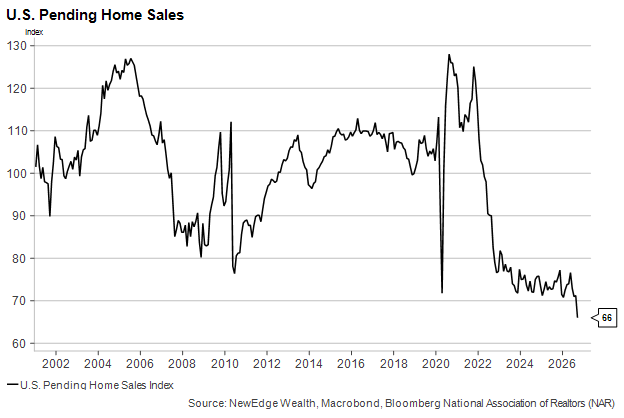
As of September 2026
This week, we’ll unmask the “ghosts” that continue to haunt the U.S. housing market. We’ll talk about what types of “exorcisms” might help bring the market back into balance and what their unintended side effects might be. Last, we’ll examine how the housing market fits into the current economic and policy outlooks. See if you can name the haunted house films (or rides) from which we’ve borrowed the “scare quotes” for each section as we go. The answers are at the bottom.
The Ghosts Haunting the Housing Market: “They’re Heeeerrrrre!”²
While it’s hard to boil down the housing market’s problems into a single cause, “unaffordability” has become the accepted term to encapsulate buyers’ frustrations and sellers’ hesitancies. And the single most important driver of poor affordability in recent years has been the increase in mortgage rates:
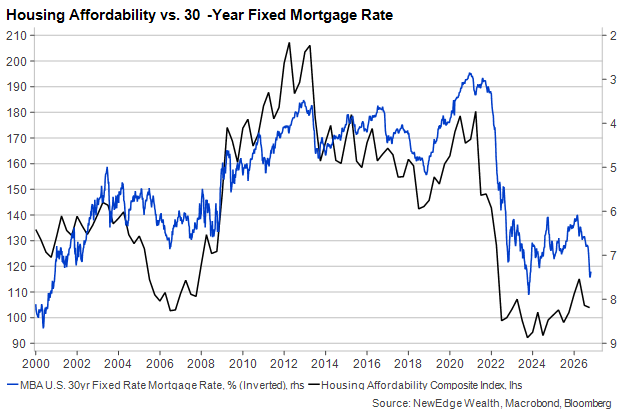
As of 10/29/26
High interest rates are the first “ghost” haunting the housing market in 2026, a relatively new occupant given that rates have only been high since 2022. But their chilling impact on buyer demand is inarguable, as this chart pitting mortgage applications against the fixed 30-year mortgage rate shows:
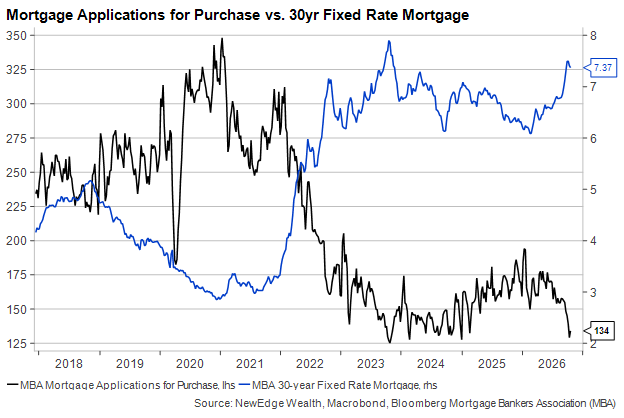
As of 10/29/26
High mortgage rates are also a disincentive to sell a home because of the second “ghost” haunting the real estate market: the legacy of low interest rates from the 2010s. While the going borrowing rate on a 30-year mortgage is close to 7.5%, the average mortgage rate for existing homeowners is more than 3 percentage points below that despite having risen over the last four years. This means that even a seller looking to downsize could see their monthly mortgage payments increase if they move. Combined with historically low turnover in the labor market, this is keeping home listings historically depressed.
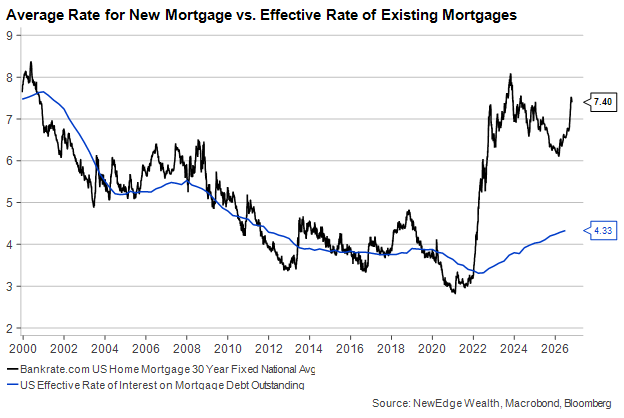
As of 10/29/26
The last “ghost” floating around the U.S. housing market is falling construction. While the early 2020s saw a boom in multi-family housing unit construction, which has contributed to a fall in rent inflation, single-family construction has failed to durably rise. Today, the rate of new home construction is barely half of what it was at the peak just before the housing crash and more than 25% below what it was at the start of the century before the bubble was forming:
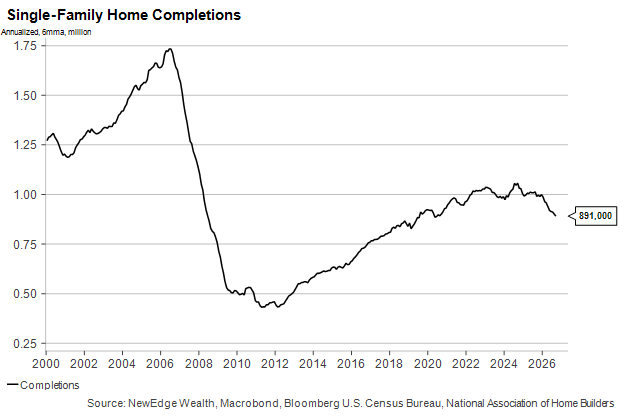
As of 10/29/26
Admittedly, the lack of new home supply is inextricably linked to the current elevated level of rates (i.e., the ghosts are intertwined). At the same time, high prices and lack of existing inventories for sale should, in theory, encourage more construction. But high building costs (labor and materials) and concerns about attracting buyers who need to finance the purchases have contributed to a historically low level of homebuilder confidence. Permit applications have followed that confidence lower, as expected:
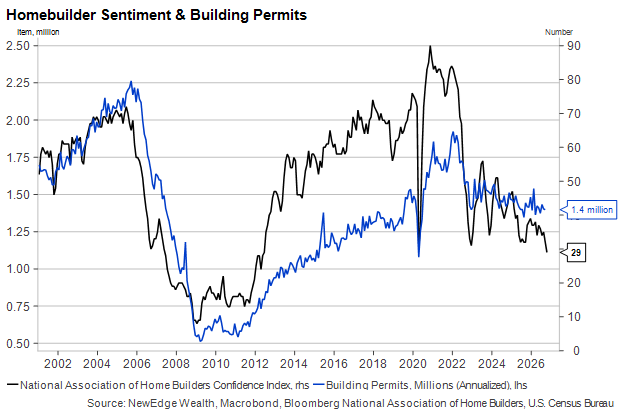
As of 10/29/26
Performing a Housing Market Exorcism: “It’s Showtime!”³
We know how this story goes. When ghosts find a house they like, they stick around until someone (a family, a religious figure, a medium, or even another ghost) kicks them out. Generally, there are two approaches. The first involves reasoning with the ghosts and eventually setting them free once an understanding is reached. The second is more direct: performing a painful exorcism that entails a cost ranging from many nights of lost sleep to considerable bodily harm.
The gentle approach to improve home affordability and increase home sales is simply to increase supply. Basic economics tells us that increased supply – for a given level of demand – reduces prices. But higher prices also invite new supply onto the market, as this next graph shows. What’s been notable about the past few years is that while home prices have continued to rise modestly nationwide, new single-family units under construction have been falling:
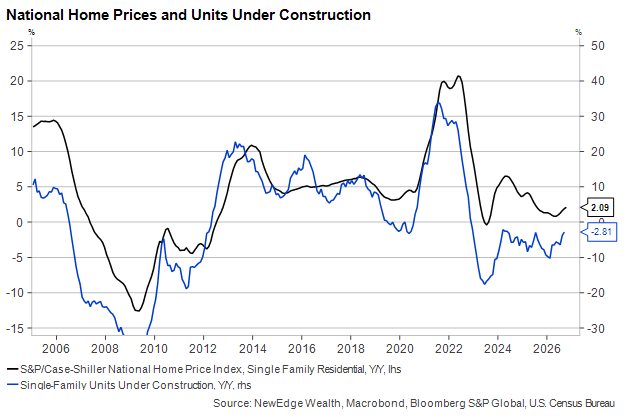
As of 10/29/26
In the haunted housing market, prices probably won’t rise fast enough to entice builders to dramatically increase production, especially when doing so risks the fragile equilibrium keeping prices supported. And while some states and localities have begun to pursue policies to increase their housing supplies over time, it’s clear the U.S. will have an undersupply of housing for the foreseeable future.
That leaves the more drastic approach to improving home affordability: lowering prices (and, eventually, interest rates) via demand destruction by slowing down the economy. Keep interest rates as high as they need to be for as long as they need to be to get inventory up as more homeowners are forced to sell because of job losses or relocations. The slowdown or recession that follows will bring rates back down naturally.
This would not be a popular policy, at least at the outset. And the Federal Reserve is the only economic entity capable of pulling it off. Its rate hikes in 2022 and 2023 loosened up housing supply and stopped the parabolic price increases. But the cuts that followed in 2024 and 2025, which helped lower mortgage rates to a degree, also supported home prices and pushed inventory growth back down. Crushing demand with higher rates is the only tried and true method for definitively exorcising a haunted housing market:
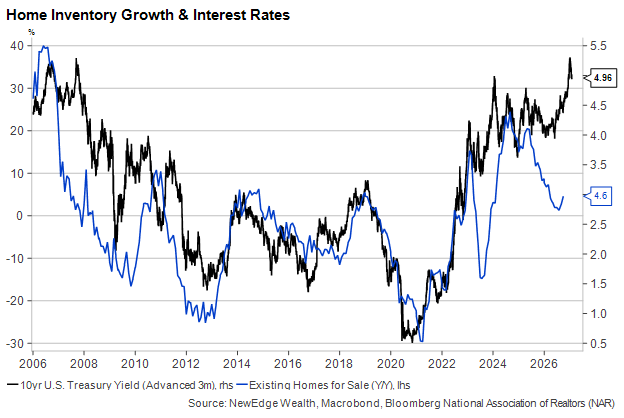
As of 10/29/26
It is often said that the cure for high interest rates is high interest rates, the implication being that rates only fall when they’ve created enough economic pain. In the same vein, many fictional hauntings only end once the house has been largely destroyed. We aren’t rooting for such an ending, and we don’t think the Fed is, either. But we are also not optimistic enough to think affordability is going to improve suddenly or significantly on its own.
Let’s Being Careful What We Wish For: “Don’t You Make No Dark Spirits Come Out!”⁴
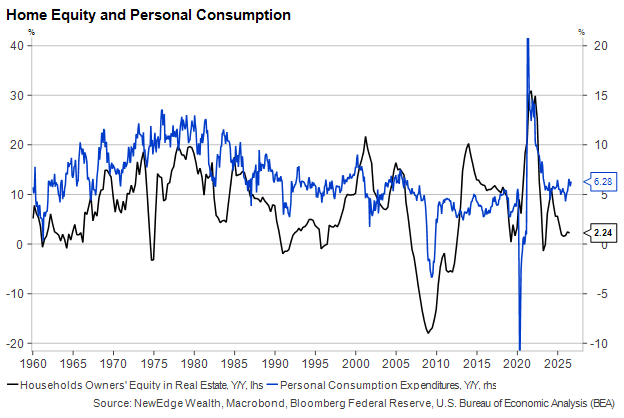
A disorderly end to the haunted housing market might benefit a cohort of aspiring homeowners, but it would cause a great deal of economic damage in the process. Up until the past few years’ equity market run, most households’ largest financial asset was their home equity. And changes in home prices, for better or worse, drove consumption patterns:
As of 10/29/26
That relationship has become less tight over time as financial asset prices (mainly stocks) have become the dominant driver of the wealth effect. Labor income growth is barely outpacing inflation, and savings rates are falling to new lows as more consumers use their wealth as a source of ever-higher spending capacity. Nevertheless, home equity remains a very large share of household net worth. If homeowners become more fearful of falling home values, the economic ripple effect could push up the savings rate and even lead to panic selling.
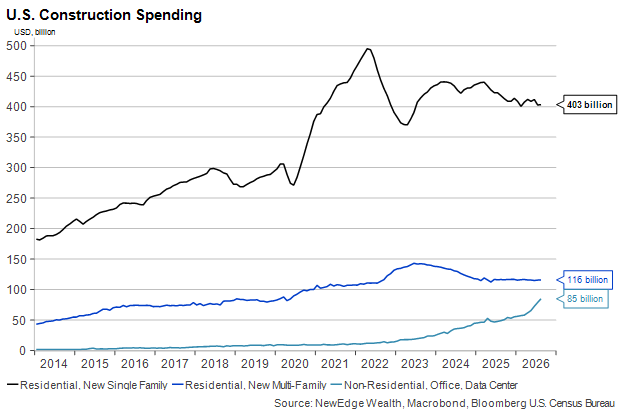
In addition to the housing-consumption link, the rise in rates necessary to deal with the haunted housing market would undoubtedly affect other forms of investment, including the fast-growing buildout of data centers to house A.I. compute capacity:
As of 10/29/26
We agree with Federal Reserve Chair Warsh’s comments last Wednesday that high interest rates have the potential to affect even this seemingly bulletproof source of capital spending growth. This is especially true for the many firms investing in A.I. that have turned to borrowing money as their excess free cash flows have run dry.
A.I. has been the goose that laid the golden egg for U.S. corporate earnings and, as a result, equity market returns. Its chief impact on the U.S. economy thus far has been the wealth it has created for households, which has helped prop up consumer spending, as we covered earlier. If those earnings should disappear (or, at least, disappoint) as a result of tighter monetary policy, the stock market and the consumer would surely feel the effects.
Conclusion: “This Chilling Challenge…To Find a Way Out!”⁵
Given interest rates’ centrality to freeing us of the ghosts haunting the housing market, it’s worth considering the Fed’s stated plans for interest rates and the extent of consumer discomfort with the current environment. The Federal Reserve’s Open Market Committee (FOMC) could have raised its policy rate this month to help tame inflation (exorcising the housing market would be a secondary and unstated goal), but it declined to do so. Its next opportunity will not come until December, by which time we fear inflation may be running hotter and long-term interest rates may rise even higher than they are today (unless equity market jitters take them down first).
Horrifying consumer sentiment readings are difficult to square with solid personal spending growth, even after controlling for inflation. High interest rates and gas prices seem to be consumers’ two main sources of displeasure. We may, in fact, see this displeasure taken out a slew of elected incumbents this upcoming Tuesday, but it’s unlikely that midterm election outcome will engender a swift decline in gas prices or mortgage rates.
Economic growth is simply too hot to permit interest rates, let alone home prices, to fall. Financial conditions remain easy. Consumers are reducing savings to cover higher gasoline prices while continuing to buy lots more of just about everything else. And A.I.-related investments, whatever their promising long-term potential to improve economic efficiency, are pushing up inflation in various sectors of the economy by creating scarcity in electronics, labor, and building materials.
All of this suggests the ghosts will continue to have free reign for now. Happy Halloween!
¹ The Haunted Mansion ride at Disney World
² Poltergeist
³ Beetlejuice
⁴ Haunted Mansion (2003)
⁵ The Haunted Mansion Ride at Disney World
IMPORTANT DISCLOSURES
The views and opinions included in these materials belong to their author and do not necessarily reflect the views and opinions of NewEdge Capital Group, LLC.
This information is general in nature and has been prepared solely for informational and educational purposes and does not constitute an offer or a recommendation to buy or sell any particular security or to adopt any specific investment strategy.
NewEdge and its affiliates do not render advice on legal, tax and/or tax accounting matters. You should consult your personal tax and/or legal advisor to learn about any potential tax or other implications that may result from acting on a particular recommendation.
The trademarks and service marks contained herein are the property of their respective owners. Unless otherwise specifically indicated, all information with respect to any third party not affiliated with NewEdge has been provided by, and is the sole responsibility of, such third party and has not been independently verified by NewEdge, its affiliates or any other independent third party. No representation is given with respect to its accuracy or completeness, and such information and opinions may change without notice.
Investing involves risk, including possible loss of principal. Past performance is no guarantee of future results.
Any forward-looking statements or forecasts are based on assumptions and actual results are expected to vary from any such statements or forecasts. No assurance can be given that investment objectives or target returns will be achieved. Future returns may be higher or lower than the estimates presented herein.
An investment cannot be made directly in an index. Indices are unmanaged and have no fees or expenses. You can obtain information about many indices online at a variety of sources including: https://www.sec.gov/answers/indices.htm.
All data is subject to change without notice.
© 2026 NewEdge Capital Group, LLC

