


How Investors Can Use Options to Reshape Risk, Return, Income, and Tax Characteristics Within a Portfolio
Investors are often familiar with traditional portfolio tools such as diversification, asset allocation, and rebalancing. Options represent another tool available to investors—one that can potentially enhance income, manage risk, facilitate portfolio transitions, and improve flexibility. While options are frequently associated with speculation, they can also play a practical role in disciplined portfolio management when implemented thoughtfully and aligned with an investor’s objectives.
The Evolution of Options: From Institutional Tool to Mainstream Portfolio Management
Options have existed in various forms for centuries, but the modern listed options market began in 1973 with the launch of the Chicago Board Options Exchange (CBOE). Prior to that time, options were largely negotiated privately between parties, making them difficult to access, expensive to trade, and often lacking transparency.
The introduction of standardized listed options transformed the marketplace. Investors could now trade contracts with uniform terms, transparent pricing, and centralized clearing, significantly reducing counterparty risk.
While these developments were important, the options market of the 1970s and 1980s remained largely an institutional arena. Trading costs were high, bid-ask spreads were wide, information was difficult to obtain, and execution often required a phone call to a broker who then relayed the order to a trading floor.
As a result, many individual investors viewed options as speculative instruments rather than practical portfolio management tools.
Over the last several decades, however, the options market has undergone a remarkable transformation.
Technology, electronic trading, increased competition among market makers, and a dramatic expansion in market participation have fundamentally changed the landscape. Today, many of the largest exchange-traded funds and publicly traded companies have highly liquid options markets with deep trading volumes and efficient pricing.
Several developments have been particularly important:
Narrower Bid-Ask Spreads: Historically, investors often paid substantial transaction costs through wide bid-ask spreads. In many actively traded securities today, spreads have narrowed considerably, allowing investors to enter and exit positions more efficiently and at lower implicit cost.
Lower Trading Costs: Commissions that once represented a meaningful barrier to implementation have declined significantly. The reduction in trading costs has made options accessible to a much broader group of investors and has increased the practicality of using options as an ongoing portfolio management tool.
Increased Liquidity: The growth of ETF investing, institutional participation, and electronic market making has dramatically increased liquidity in many option markets. Greater liquidity typically leads to more efficient pricing, improved execution, and greater flexibility when managing positions.
Enhanced Transparency: Real-time pricing, sophisticated analytics, and broad access to market information have provided investors with tools that were once available only to professional traders and institutions.
These developments have changed the role of options within investment portfolios. Rather than serving primarily as speculative instruments, options can now be utilized as practical tools for generating income, managing risk, and improving portfolio efficiency.
Today, many institutional investors, pension plans, endowments, family offices, and wealth managers incorporate options as part of a disciplined investment process designed to enhance long-term outcomes while maintaining appropriate risk controls.
Understanding Options
At their core, options are simply contracts tied to an underlying investment such as a stock, exchange-traded fund (ETF), or market index.
There are two primary types of options:
Call Options
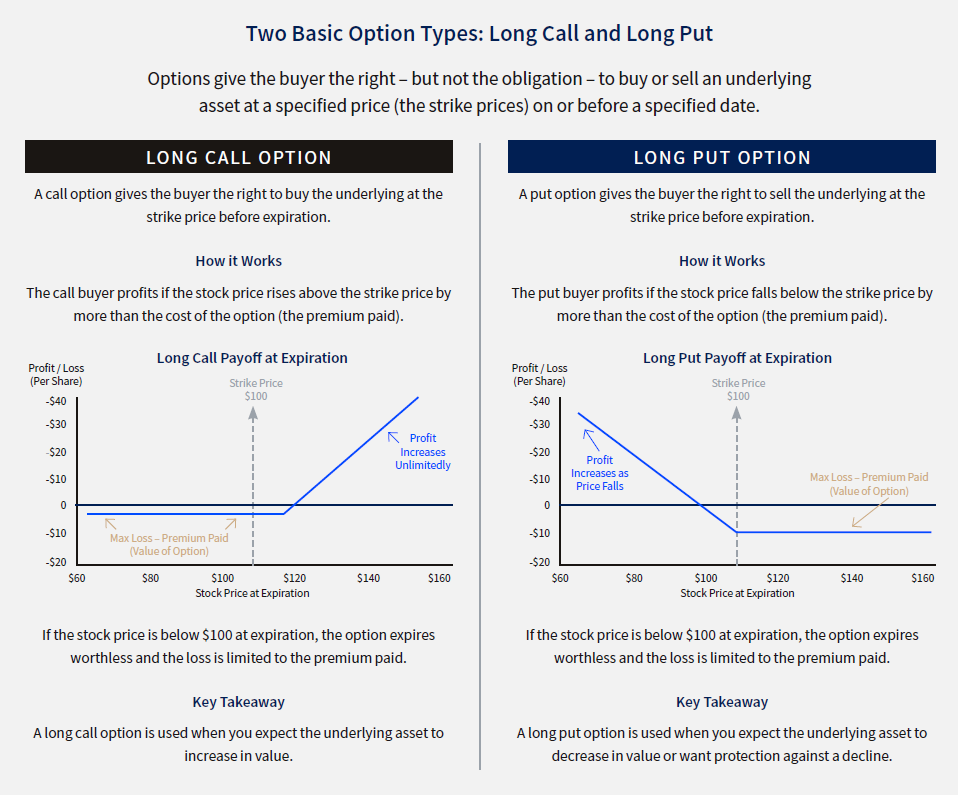
A call option gives its owner the right to buy a security at a predetermined price, known as the strike price, before a specified expiration date. Investors often use call options when they believe an asset may rise in value. Call options can also be sold by investors who already own the underlying security. In exchange for accepting a potential obligation to sell shares at a predetermined price, the investor receives an upfront premium. This approach, known as a covered call strategy, is one of the most common ways investors use options to generate additional portfolio income.
Put Options
A put option gives its owner the right to sell a security at a predetermined price before expiration. Investors often purchase put options as a form of portfolio protection. Much like an insurance policy on a home or automobile, a put option can help protect against significant declines in the value of an investment. While this protection comes at a cost, many investors find value in limiting downside risk during periods of heightened market uncertainty.
Options as Portfolio Tools
Options are not investments in and of themselves. Rather, they are tools that can be used to modify the risk and return characteristics of an existing portfolio.
Depending on the strategy employed, options can be used to:
- Generate additional income
- Reduce downside risk
- Improve portfolio cash flow
- Enhance risk-adjusted returns
- Create more predictable investment outcomes
The objective is not necessarily to outperform the market in every environment. Instead, the goal is often to create a portfolio experience that is better aligned with an investor’s specific objectives and risk tolerance.
Practical Applications of Options in Wealth Management
1. Enhancing Portfolio Income
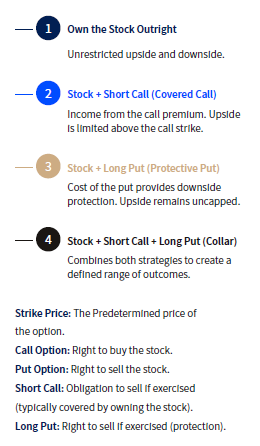
Many investors own high-quality stocks and ETFs that they intend to hold for years. In these situations, covered call strategies can potentially generate additional cash flow from existing holdings. By agreeing to sell a position at a predetermined price in the future, investors receive an upfront premium. This premium can supplement dividends, interest income, and portfolio withdrawals. For retirees and income-oriented investors, covered calls can create an additional source of cash flow without requiring the sale of portfolio assets.
Key concept: Generating income from assets already owned.
2. Getting Paid While Building New Positions
One of the lesser-known applications of options involves investors who have cash available but are waiting for attractive entry points. Rather than placing a limit order and waiting, investors can sell cash-secured put options at prices where they would be willing to purchase a security. If the security declines to the predetermined price, they acquire the shares at their desired level. If the security remains above that price, the investor retains the premium received from selling the option. In essence, investors are being compensated while waiting for an opportunity to invest.
Key concept: Getting paid to wait.
3. Assisting Portfolio Rebalancing
Strong market appreciation can cause portfolios to become more heavily weighted toward equities than originally intended. Rather than immediately selling appreciated positions, investors may use covered calls to establish future exit prices while collecting option premium along the way. If markets continue higher, shares may eventually be called away at predetermined prices, helping move the portfolio toward its target allocation. If markets remain flat or decline, the investor retains the premium income.
Key concept: Getting paid while rebalancing risk.
4. Managing Concentrated Stock Positions
Many successful investors, founders, executives, and long-term employees accumulate substantial positions in a single company. While diversification may be desirable, immediate liquidation can create significant tax consequences.
Options can provide additional flexibility by allowing investors to:
- Generate income from concentrated holdings
- Create structured exit plans over time
- Establish price targets for gradual diversification
- Reduce portfolio volatility
- Potentially defer realization of gains
Options do not eliminate concentration risk, nor do they eliminate taxes. However, they can create a more deliberate and tax-aware path toward diversification. This can be particularly relevant for founders, executives, and long-term employees whose financial success has become closely tied to the fortunes of a single company.
Key concept: Managing concentration risk without forcing an immediate taxable event.
5. Managing Investor Behavior
Many investors believe risk management means predicting market declines. In reality, risk management is often about helping investors stay committed to a long-term investment plan. Option strategies can create more predictable ranges of outcomes by generating income, reducing volatility, or establishing downside protection. When investors experience smaller swings in portfolio value, they are often less likely to make emotionally driven decisions during periods of market stress.
Key concept: Sometimes the greatest risk is investor behavior, not market volatility.
Why Active Management Matters
While option strategies may appear straightforward on the surface, successful implementation often requires ongoing analysis, monitoring, and adjustment. Two investors may own the same stock and employ the same general strategy, yet experience very different outcomes based on how the strategy is executed. The value is not simply in the option itself. The value is in how the option strategy is integrated into the broader portfolio and aligned with the investor’s objectives.
Every Investor’s Goals Are Different
An investor seeking current income may utilize options differently than an investor focused on long-term growth. Likewise, a retiree seeking portfolio distributions may have different objectives than a business owner managing a concentrated stock position. Effective option strategies begin with understanding the investor’s goals, risk tolerance, tax situation, liquidity needs, and time horizon.
Position Selection Matters
Not every stock or ETF is an ideal candidate for an option strategy. Factors such as liquidity, trading volume, volatility, portfolio weighting, and tax considerations can all influence whether a particular position is suitable. The objective is not to apply options indiscriminately across a portfolio, but rather to identify situations where options may improve the overall investment experience.
Strike Prices Matter
One of the most important decisions in any option strategy is selecting an appropriate strike price. A strike price that is too conservative may generate little benefit, while a strike price that is too aggressive may unnecessarily limit future opportunities. The selection process should reflect both market conditions and the investor’s specific objectives.
Timing Matters
Options are available with a variety of expiration dates ranging from days to years. Shorter-term options may provide greater flexibility and more frequent opportunities to adjust positions. Longer-term options may provide greater predictability and reduce transaction frequency. Determining the appropriate time horizon is an important component of the overall strategy.
Tax Considerations Matter
For many investors, after-tax outcomes are ultimately more important than pre-tax returns. Option strategies can affect holding periods, realized gains, portfolio turnover, and cash flow. As a result, tax implications should be considered alongside investment objectives when designing and managing a strategy.
Options Should Serve the Portfolio—Not the Other Way Around
Perhaps most importantly, option strategies should support the broader objectives of the portfolio. The purpose is not to maximize option premium or increase trading activity. The purpose is to help investors pursue their financial goals in a manner that is consistent with their risk tolerance, tax circumstances, and long-term investment plan. When implemented thoughtfully, options can become a valuable portfolio management tool. However, their effectiveness often depends less on the strategy itself and more on the discipline and judgment applied throughout the management process.
Options Are Powerful Tools—But Not Universal Solutions
Like any investment tool, options can be highly effective when applied appropriately. However, they are not suitable for every investor, every security, or every market environment. At NewEdge Wealth, we view options as one component of a broader portfolio management process rather than a standalone investment strategy.
Not Every Investment is a Good Candidate
Certain securities may have limited trading activity, wider bid-ask spreads, or insufficient liquidity to support efficient option implementation. In these cases, the potential benefits of an option strategy may not justify the associated costs or risks. Likewise, some investments may possess return characteristics that make option overlays less attractive than simply maintaining direct ownership. The decision to utilize options should always begin with the investor’s objectives rather than the availability of the strategy itself.
Options Involve Tradeoffs
One of the most important concepts for investors to understand is that options do not create returns without tradeoffs. For example:
- Generating additional income through covered calls may limit some future upside participation.
- Purchasing downside protection through put options involves a cost.
- Managing concentrated stock positions with options may reduce risk, but does not eliminate it.
Successful implementation requires understanding both the benefits and the compromises associated with each strategy.
What Options Cannot Do
While options can be valuable portfolio management tools, they cannot:
- Eliminate market risk
- Guarantee positive investment returns
- Prevent losses in all market environments
- Eliminate tax liabilities
- Replace a disciplined investment process
Rather than serving as a substitute for sound portfolio construction, options are most effective when used to complement a thoughtful investment strategy.
The Importance of Active Oversight
The effectiveness of any option strategy depends on ongoing evaluation and management. Market conditions change. Portfolio objectives evolve. Tax considerations shift over time. As a result, option strategies often require periodic adjustments to remain aligned with an investor’s goals and risk tolerance. The objective is not to use options simply because they are available. The objective is to determine when they can meaningfully improve a portfolio’s risk, return, income, or tax characteristics while remaining consistent with the investor’s broader financial plan.
Conclusion
Options are often associated with speculation, complexity, and short-term trading. Yet for many institutional investors, family offices, endowments, and sophisticated wealth managers, options have long served a very different purpose. When used thoughtfully, options can help investors address a variety of portfolio challenges, including generating income, building new positions, managing concentration risk, assisting portfolio rebalancing, and supporting tax-aware portfolio management. Perhaps most importantly, options provide investors with additional flexibility. Rather than relying solely on buying and selling securities, investors can use options to help shape how a portfolio behaves under different market conditions.
Options are not investments. They are tools that allow investors to reshape the risk, return, income, and tax characteristics of an existing portfolio.
Like any tool, their effectiveness depends on how they are applied. Not every strategy is appropriate for every investor, and successful implementation requires thoughtful analysis, active oversight, and a clear understanding of the tradeoffs involved. When integrated into a disciplined investment process, options can become a valuable complement to traditional portfolio management—helping align a portfolio more closely with an investor’s goals, objectives, and long-term financial plan.
The objective is not to predict the future. The objective is to build a portfolio that is better prepared for it.
IMPORTANT DISCLOSURES
Multi-leg options strategies (e.g., spreads, collars, straddles) may involve additional complexity, transaction costs, and risks not present in single-option positions, including the risk that individual legs may not execute simultaneously or as intended.
The tax treatment of options transactions can be complex and may vary based on the specific strategy employed, the investor’s holding period, and individual circumstances. Investors should consult a qualified tax advisor prior to entering into any options transaction.
Options strategies discussed herein are provided for informational and educational purposes only and do not constitute a recommendation or investment advice. There is no guarantee that any options strategy will achieve its intended objective, and past performance is not indicative of future results.
Options strategies may not be suitable for all investors depending on their financial situation, investment objectives, risk tolerance, and time horizon. Investors should consult with their financial and tax advisors before implementing any options-based strategy.
The views and opinions included in these materials belong to their author and do not necessarily reflect the views and opinions of NewEdge Capital Group, LLC.
This information is general in nature and has been prepared solely for informational and educational purposes and does not constitute an offer or a recommendation to buy or sell any particular security or to adopt any specific investment strategy.
NewEdge and its affiliates do not render advice on legal, tax and/or tax accounting matters. You should consult your personal tax and/or legal advisor to learn about any potential tax or other implications that may result from acting on a particular recommendation.
The trademarks and service marks contained herein are the property of their respective owners. Unless otherwise specifically indicated, all information with respect to any third party not affiliated with NewEdge has been provided by, and is the sole responsibility of, such third party and has not been independently verified by NewEdge, its affiliates or any other independent third party. No representation is given with respect to its accuracy or completeness, and such information and opinions may change without notice.
Investing involves risk, including possible loss of principal. Past performance is no guarantee of future results.
Any forward-looking statements or forecasts are based on assumptions and actual results are expected to vary from any such statements or forecasts. No assurance can be given that investment objectives or target returns will be achieved. Future returns may be higher or lower than the estimates presented herein.
An investment cannot be made directly in an index. Indices are unmanaged and have no fees or expenses. You can obtain information about many indices online at a variety of sources including: https://www.sec.gov/answers/indices.htm.
All data is subject to change without notice.
© 2026 NewEdge Capital Group, LLC

