


Introduction: “You keep using that word…”
The most enduring character in the Rob Reiner’s The Princess Bride, a film teeming with iconic actors in iconic roles, is the diminutive “genius” kidnapper, Vizzini, played with delightful malice by Wallace Shawn. At every turn, confronted with even the most minor of obstacles or setbacks, his one-word exclamation is always the same: “Inconceivable”. When his partner in crime, Inigo, finally informs him that the word doesn’t mean what he thinks it means (inconceivable things don’t happen several times a day to a single person, after all), Vizzini walks off in a huff.
We can’t be too hard on Vizzini considering that it seemed inconceivable to most at the start of the year that inflation would be the biggest macroeconomic risk heading into 2027. But as we fast approach the turn of the year, it is, indeed, inflation that has taken center stage. Last week’s releases of core consumer and producer price inflation for October both came in hotter than expected, triggering a domino effect of more hawkish Fed rhetoric and a sharp rise in interest rates.
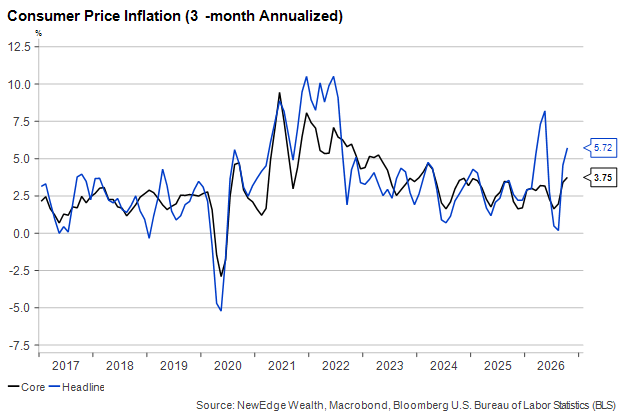
This graph of the annualized 3-month inflation rate shows the momentum in consumer price inflation is getting worse again:
As of October 2026
Unless and until this trend reverses and the 4-5% inflation rate we have been dealing with over the last several months quickly eases to 2-3%, the Fed will need to raise its policy rate further. We know from recent experience what that can do to a diversified portfolio. It’s entirely conceivable (!) that higher rates will hit both stocks and bonds, meaning more pain ahead for investors.
Inflation Won’t Go Away: “You fell victim to one of the classic blunders!”
We subscribe to Milton Friedman’s assertion that inflation is “always and everywhere a monetary phenomenon.” After the experiments with rapid money supply growth following both the 2008 financial crisis and 2020 pandemic, we’d add one point of clarification: inflation shows up when the supply of money is greater than the demand for it. When investors are hoarding cash, as they were in those periods, almost no increase in the money supply can stimulate inflation. When investors are spending cash, as they were in 2022 and to a lesser extent are in 2026, inflation starts to bite.
After a string of rate cuts in 2024 and 2025, monetary policy is now much looser than it was when the Federal Funds rate was at its peak in 2023. But inflation is running well above 2% even with policy a policy rate of close to 4%, which was unimaginably high to anyone around in the 2010s. Why won’t inflation go away? (“He didn’t fall?! Inconceivable!”)
Up to this point, much of the excess inflation in 2026 has been a result of a relatively narrow basket of goods over which the Fed has little to no control. But a slew of policy decisions coming out of Washington, D.C. – while certainly not designed to cause inflation – have contributed in some way to today’s elevated rate.
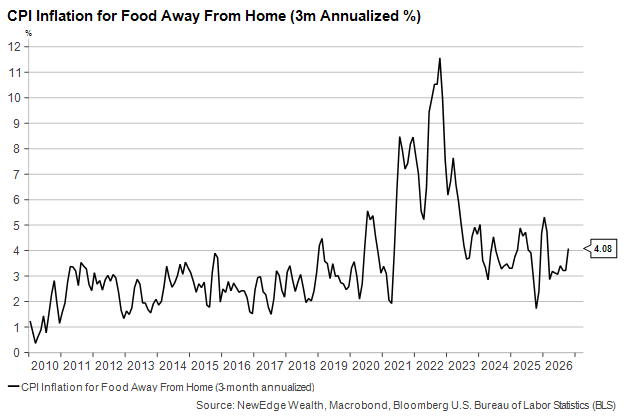
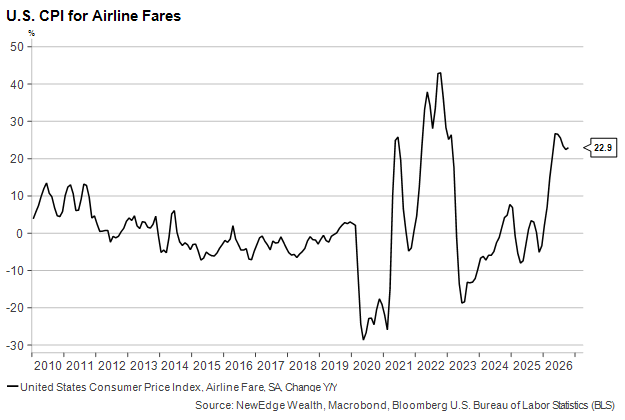
First and foremost, ongoing military conflicts in Ukraine and Iran (“never get involved in a land war in Asia!”) have contributed to sharp and lasting spikes in global energy prices. Food price inflation momentum has returned, partly due to higher transportation costs, and high energy prices have quickly contributed to surging airfares, as the next two graphs show:
As of October 2026
As of October 2026
Second, tariffs, even at diminished rates, have pushed up prices of both imports and domestically produced goods (many of which are priced to compete with imports), higher than they would be otherwise.
Third, and more subtly, the fiscal stimulus that passed in 2025 may have contributed to greater consumer resilience in the first half of this year, especially for those at the lower end of the income scale. This meant that high gasoline prices were not necessarily offset by lower prices on other goods or services due to forced substitution. And the tax breaks for business investment – in addition to tariff carveouts for AI-specific buildouts – helped encourage growth in capital expenditures. This has contributed to higher prices on specific goods like electronics and batteries, and, arguably, helped push interest rates up as competition for borrowers grew.
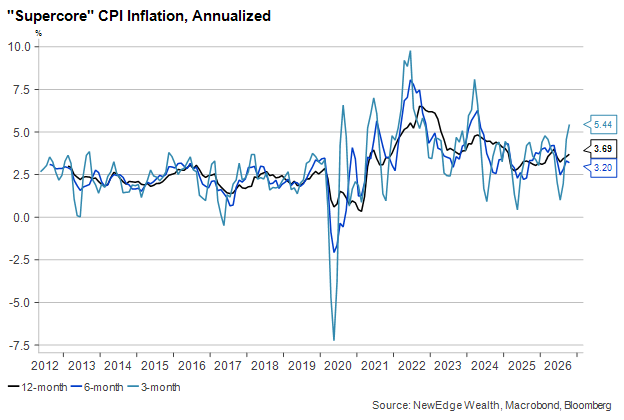
What made the October inflation data more alarming (Chicago Fed President Austan Goolsbee called it “borderline disturbing”) is that it showed continued inflation broadening out from “one-offs” driven by geopolitics or domestic tax policies into other areas that have proven more difficult to reverse over time. So-called “supercore” CPI inflation, which includes services prices but excludes food, energy and shelter, has risen at close to a 5.5% rate over the past three months. This category includes airfares but also major ticket items like insurance and medical costs that are not directly influenced by energy prices:
As of October 2026
Even more concerning, the yearslong downward trend in shelter inflation, which is a very large share of overall CPI, appears to be nearing an end. Leading indicators tell us to expect an inflection higher in rent inflation by this time next year if not sooner. If shelter is no longer helping push down inflation, as it has since 2023, it’s much harder to see how we get to 2% anytime soon.
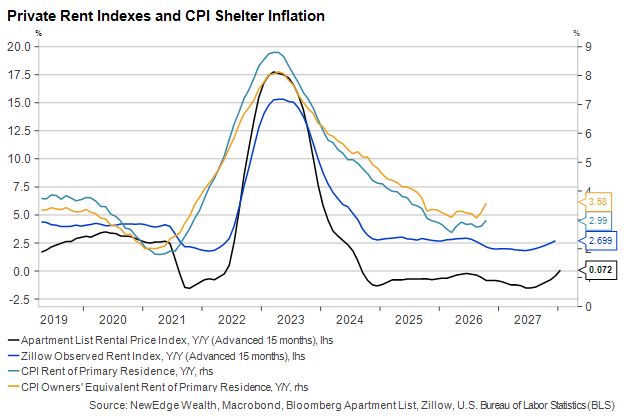
As of October 2026
Disinflationary Election Results: “If he falls, fine. If not, the sword.”
Inflation was clearly a big issue in the recent U.S. midterm elections, the outcome of which will be a unified Congress controlled firmly by the Democrats, who will likely oppose most of President Trump’s agenda in the final two years of his presidency. While no legislation that meaningfully eases cost-of-living burdens is likely to pass (beyond, perhaps, the energy project permitting reform bill currently winding through the lame duck session of this Congress), at least one source of disinflation is already showing in market prices:
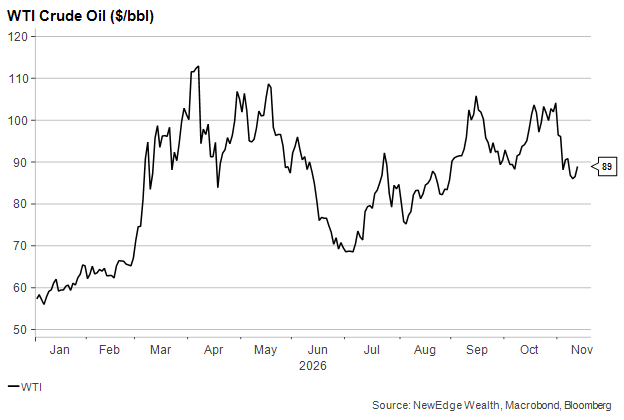
As of 11/12/26
Oil prices remain well above the levels at which they began the year, and it’s normal for them to fall in the fourth quarter. But the drop since the election has been at least partly driven by a growing consensus that the U.S. will not escalate its campaign against Iran to a point that could further threaten energy infrastructure in the region.
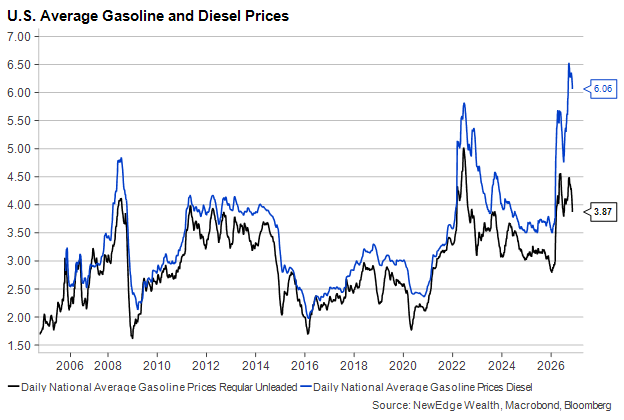
As of 11/12/26
Retail gasoline and diesel prices have, likewise, fallen, which should show up as lower headline inflation in November and some easing in secondary prices like airfares in the coming months. But as we pointed out above, it’s more than just energy keeping inflation elevated, and it will take more than energy price moderation to bring it down to target.
Fed Rate Hike Risks Growing: “Hurry up! Move the thing. And that other thing!”
It’s easy to forget that the Federal Reserve was still cutting interest rates as recently as last December and was expected to cut further this year until the start of the Iran conflict. But with the now Fed back in tightening mode, financial conditions are somewhat less easy than they started the year, and the Treasury yield curve has begun to flatten once again:
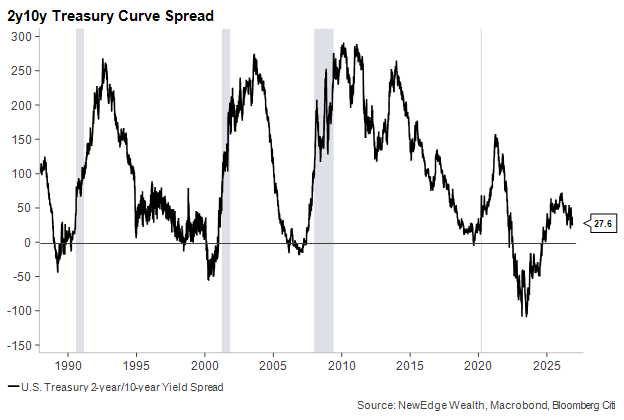
As of 11/12/26
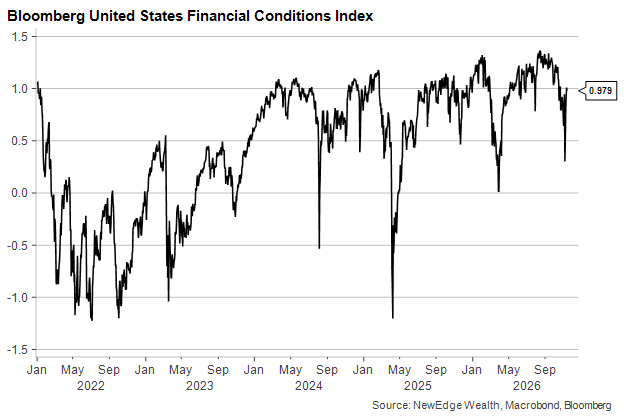
As of 11/12/26
Public comments from Fed officials last week took a notable turn toward the hawkish, with Governor Chris Waller floating a larger 50bps hike at the next meeting in December and several Fed presidents calling for a more rapid pace of increases. The result has been a sharp repricing of the market-based path of Fed policy over the next year:
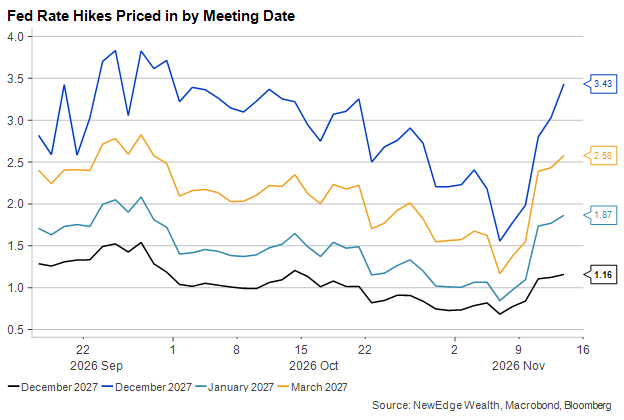
As of 11/12/26
Whether this projection comes to fruition depends largely on how financial markets behave. A wider ripple from the Nvidia fallout and general AI earnings concerns could send equity markets tumbling and stay the Fed’s hand beyond December. Likewise, any signs of contagion in credit markets stemming from AI-related financing concerns could reduce the need to tighten policy.
AI Impact in Focus: “I do not accept excuses. I’m just going to have to find myself a new Giant, that’s all”
Before we conclude our look at inflation with its impact on various asset prices, we must note the potential impacts that this week’s leadership change at one of the most important companies in the AI infrastructure ecosystem could have on both the market and macro landscape.
For background, Nvidia (NVDA) is the second largest weight in the S&P 500 at about 6% (down from being the largest at 8.5% earlier this year) and the second largest weight in the Nasdaq 100 at over 10%. This means that any index investor has significant exposure to the vicissitudes of NVDA’s board room and stock price volatility. The wealth effect – rising asset prices fueling rising spending – has been an important source of consumer resilience in 2026 (the chart below shows how household consumption forecasts are higher today than they were prior to the energy price shock). A period of softer equity market returns raises the risk we enter a period of softer consumer spending.
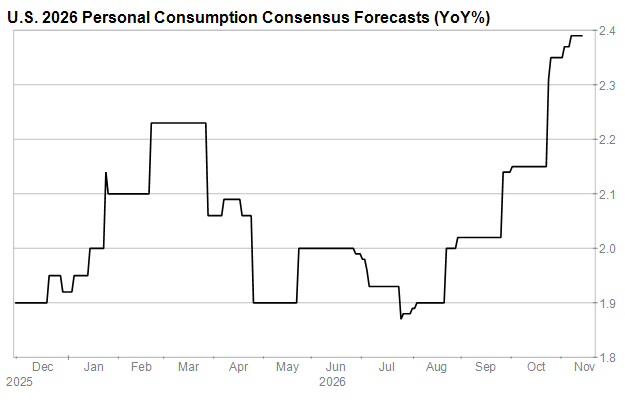
As of 11/12/26
NVDA’s willingness and ability to use the fortress of its own balance sheet to backstop more indebted and nascent companies in the AI ecosystem has played an important role in fueling the supernormal growth of the AI buildout, which has benefitted U.S. economic growth through higher fixed investment, as shown below. If NVDA’s controversies spur a rethink of the company’s willingness and ability to invest in other players, the ripple through the AI infrastructure ecosystem could challenge consensus expectations for another year of extraordinary growth in 2027. For example, Morgan Stanley currently expects 70% growth in data center capex next year, and sell-side consensus estimates 55% earnings growth for the semiconductor industry in 2027.
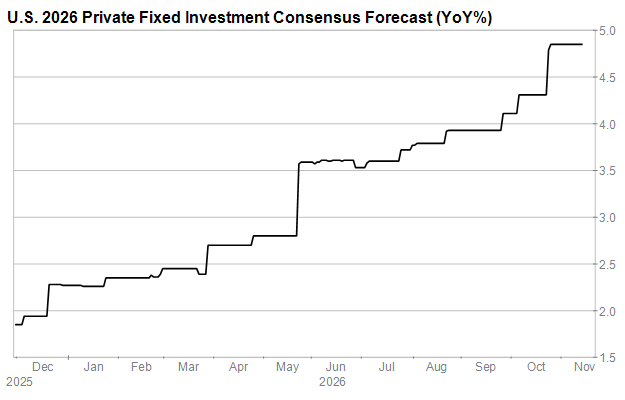
As of 11/12/26
Conclusion: “You’ve given everything away! I know where the poison is!”
The playbook for investing during a period of rising interest rates, which had accumulated several inches of dust from 2008 through 2021, has been a must read for the past five years and running. So-called inflation hedges like gold, TIPS, and cryptocurrencies have severely underperformed a diversified portfolio of stocks and bonds in 2026. The U.S. dollar is at its highest level since Liberation Day. This is a signal that investors have faith in the Federal Reserve and other central banks to do what is necessary (i.e., raise rates) to control inflation.
As monetary policy moves in a tighter direction, it is normal for valuations on risk assets like equities to fall, which we have seen throughout 2026. Not all companies and sectors carry the same degree of interest rate risk, but this graph shows that during every recent tightening cycle – 2018, 2022 and now 2026 – S&P 500 valuations have fallen. What makes this year’s decline slightly different, as we pointed out in last week’s piece, is the fact that earnings estimates have surged:
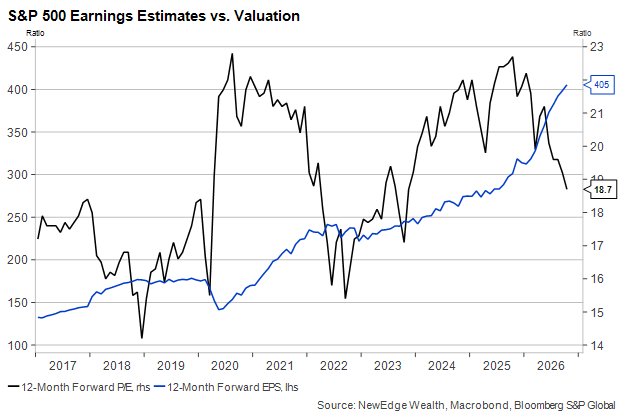
As of 11/12/26
The glass half full view of the situation is that valuations have fallen while the broader economy and, specifically, earnings derived from the AI buildout continue to grow, offering investors a potentially fruitful entry point. The glass half empty side would point out that valuations rarely if ever expand during a Fed tightening cycle, and that troughs in valuations often occur just as earnings estimates are about to be cut.
Turning to bonds, it’s been frustrating to see bond yields soar again this week (and prices fall) after such a promising month of returns. The silver lining here is that investors may yet have another bite at the apple for a tactical buying opportunity. Corporate credit spreads remain tight, but underlying Treasury yields are elevated across all maturities. A 5-6% yield on investment grade bonds can serve as a sturdy anchor for diversified portfolios entering stormy waters.
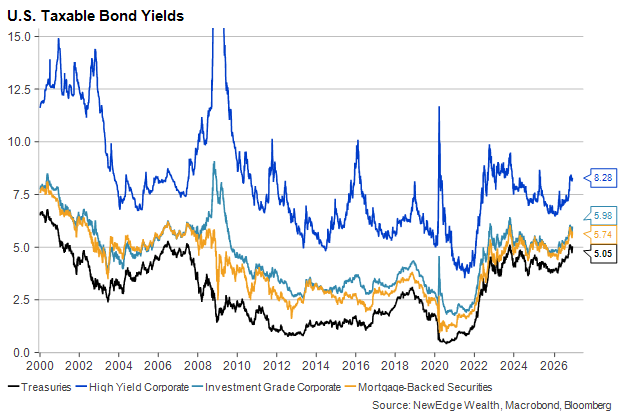
As of 11/12/26
The clock has run out for those hoping to avoid the consequences of inflationary fiscal and foreign policy. Oil prices are unlikely to fall back to their early 2026 lows, and the chances of a massive increase in housing supply to ease shelter costs seem even more remote. The labor market seems, if anything, to be warming up a bit, providing another potential source of price pressures soon.
Now is the time for the Fed to step in and grapple in a serious way with fulfilling its inflation mandate. Whether the Fed will, like Vizzini, have to scale up the Cliffs of Insanity with a prolonged and painful tightening cycle or deliver the coup de grace with a single blow (as he instructs his giant, Fezzik, to do) depends on how markets behave and how quickly core inflation readings turn back down.
IMPORTANT DISCLOSURES
The views and opinions included in these materials belong to their author and do not necessarily reflect the views and opinions of NewEdge Capital Group, LLC.
This information is general in nature and has been prepared solely for informational and educational purposes and does not constitute an offer or a recommendation to buy or sell any particular security or to adopt any specific investment strategy.
NewEdge and its affiliates do not render advice on legal, tax and/or tax accounting matters. You should consult your personal tax and/or legal advisor to learn about any potential tax or other implications that may result from acting on a particular recommendation.
The trademarks and service marks contained herein are the property of their respective owners. Unless otherwise specifically indicated, all information with respect to any third party not affiliated with NewEdge has been provided by, and is the sole responsibility of, such third party and has not been independently verified by NewEdge, its affiliates or any other independent third party. No representation is given with respect to its accuracy or completeness, and such information and opinions may change without notice.
Investing involves risk, including possible loss of principal. Past performance is no guarantee of future results.
Any forward-looking statements or forecasts are based on assumptions and actual results are expected to vary from any such statements or forecasts. No assurance can be given that investment objectives or target returns will be achieved. Future returns may be higher or lower than the estimates presented herein.
An investment cannot be made directly in an index. Indices are unmanaged and have no fees or expenses. You can obtain information about many indices online at a variety of sources including: https://www.sec.gov/answers/indices.htm.
All data is subject to change without notice.
© 2026 NewEdge Capital Group, LLC

