


Latest Update:
As of August 14, 2026, there is pending litigation challenging the rollout of this tax. While the lawsuits filed do not challenge the legality of the tax itself, certain aspects of the implementation of it are pending legal review. The next hearing is scheduled for August 31, 2026.
As part of New York’s Fiscal Year 2027 Budget, the state enacted an annual surcharge on certain high-value New York City residences that are not used as the owner’s primary home. The tax took effect July 1, 2026, and the city has just extended the deadline for owners to apply for an exemption to September 18, 2026. Below is a summary of what it is, who is affected, and what to do next.
Overview
The new ‘pied-à-terre’ surcharge is designed to target luxury residences used as second homes or occasional-use properties. This is imposed in addition to traditional property taxes.
The surcharge applies to the following New York City residential property types when not used as a primary residence:
- One-, two-, and three-family homes and townhouses
- Condominium units
- Cooperative apartments
The law also contains ‘look-through’ ownership provisions that would attribute ownership to individuals when a property is held through a trust, LLC, partnership, corporation, or other entity.
Primary Residence Exception
The surcharge does not apply if the property serves as the primary residence of:
- The owner
- Certain immediate family members (spouse, child, parent, sibling, grandparent, or grandchild)
- A tenant occupying the property under a bona fide lease of at least one year
One open question is whether the surcharge applies to ‘statutory residents’, or those individuals domiciled outside New York City who nonetheless qualify as City residents by spending more than 183 days there each year. Based on the current legislation, it appears the surcharge may still apply, since a person domiciled elsewhere cannot, by definition, treat a New York City property as their primary residence. Until the NYC Department of Finance issues further guidance, this tax risk should be treated as a potential exposure rather than a certainty.
Tax Rates: Two Phases
Phase One (July 1, 2026 – June 30, 2028)
One-, Two-, and Three-Family Homes:
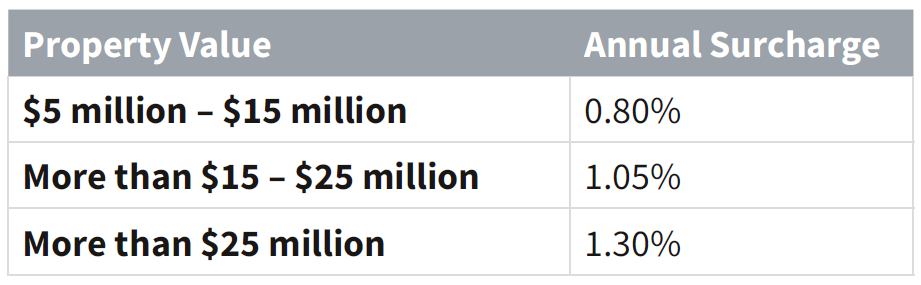
Note: The valuation for these homes is based on the Department of Finance’s existing methodology in calculating traditional property tax bills.
Condominium and Cooperative Units:
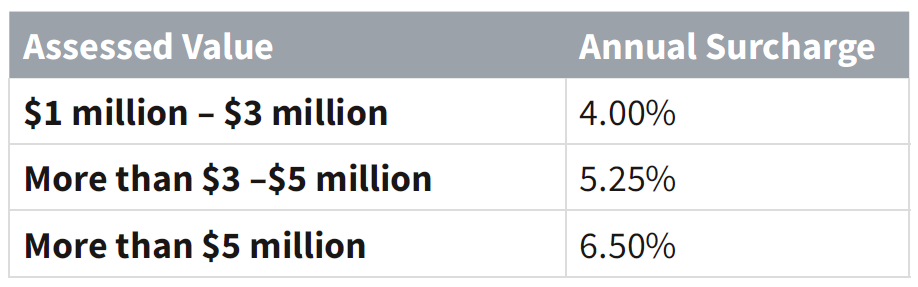
Note: The rates appear higher for condo and co-op units because they are also valued using the Department of Finance’s existing methodology, but this methodology historically produces assessed values well below actual market prices. The lower thresholds and higher rates should therefore be viewed together.
Phase Two (Beginning July 1, 2028)
Beginning July 1, 2028, condominium and cooperative units will be valued using a comparable-sales methodology that more closely approximates fair market value. At that point, the separate condo/co-op rules end, and all covered properties move to the same $5 million threshold and the rate structure shown above for homes.
Key Deadlines
- By August 30, 2026: The Department of Finance will notify owners it believes may be subject to the surcharge. Letters went out via mail beginning July 23, 2026.
- September 18, 2026: Extended deadline for owners who received a notice to apply for a primary-residence exemption (announced by the Mayor’s Office on August 1, 2026.)
- Owners must choose one appeal path: the Tax Commission (disputes over the assessed amount) or the Department of Finance (disputes over primary-residence classification) — not both.
Cooperative Owners and Boards
The Department of Finance will add the surcharge for each subject unit directly to a cooperative building’s overall property tax bill, and the co-op board is responsible for collecting the tax from the applicable tenant-shareholders. If a shareholder fails to pay, the unpaid amount can result in a lien on the entire building. It is advised that boards revisit proprietary leases, residency disclosures, and collection procedures in light of this risk.
What You Should Do Now
- Review whether your property qualifies as your primary residence, or that of a qualifying family member or tenant.
- Check your property’s annual Notice of Property Value and any notice received from the Department of Finance to assess the valuation.
- Revisit ownership structures involving trusts, LLCs, or other entities in light of the look-through rules.
- If you received a “You may be subject to…” notice, submit an exemption application before the September 18, 2026 deadline.
- If you serve on or advise a co-op board, review collection procedures and lease provisions for tenant-shareholder delinquencies.
We are closely monitoring guidance from the New York City Department of Finance.
Broader Trend
NYC’s pied-à-terre tax is part of a broader trend of states and localities taxing second homes and high-value non-primary residences. Montana adopted a similar rate structure on non-owner-occupied homes in 2025, and Rhode Island, Hawai’i County, and Washington, D.C. have each moved toward higher property tax rates targeting vacation homes and high-value properties.
IMPORTANT DISCLOSURES
The views and opinions included in these materials belong to their author and do not necessarily reflect the views and opinions of NewEdge Capital Group, LLC.
This information is general in nature and has been prepared solely for informational and educational purposes and does not constitute an offer or a recommendation to buy or sell any particular security or to adopt any specific investment strategy.
NewEdge and its affiliates do not render advice on legal, tax and/or tax accounting matters. You should consult your personal tax and/or legal advisor to learn about any potential tax or other implications that may result from acting on a particular recommendation.
The trademarks and service marks contained herein are the property of their respective owners. Unless otherwise specifically indicated, all information with respect to any third party not affiliated with NewEdge has been provided by, and is the sole responsibility of, such third party and has not been independently verified by NewEdge, its affiliates or any other independent third party. No representation is given with respect to its accuracy or completeness, and such information and opinions may change without notice.
Investing involves risk, including possible loss of principal. Past performance is no guarantee of future results.
Any forward-looking statements or forecasts are based on assumptions and actual results are expected to vary from any such statements or forecasts. No assurance can be given that investment objectives or target returns will be achieved. Future returns may be higher or lower than the estimates presented herein.
An investment cannot be made directly in an index. Indices are unmanaged and have no fees or expenses. You can obtain information about many indices online at a variety of sources including: https://www.sec.gov/answers/indices.htm.
All data is subject to change without notice.
© 2026 NewEdge Capital Group, LLC

