


Time to get the seeds into the cold ground.
It takes a while to grow anything,
Before it’s coming to the end, yeah.
“Sowing Season (Yeah)”, Brand New
Listeners of the Long Island’s Brand New, may think their 2006 song “Sowing Season (Yeah)” is just another post-hardcore emo song about broken friendships or jilted lovers.
Instead, “Sowing Season (Yeah)” has deeper meaning and inspiration (though, in truth, even the Brand New songs about broken friendships and jilted lovers have deeper meaning, like “Seventy Times 7” coming from the Parable of the Unforgiving Servant).
“Sowing Season (Yeah)” borrows some of its lyrics from lines in Rudyard Kipling’s poem If-, of which a picture hung on the wall of singer Jesse Lacey’s childhood home. For example, Lacey mutters quoting Kipling, “Is it in you now / To watch the things you gave your life to broken / And stoop and build them up with warn-out tools?”
Both the Brand New song and the Kipling poem are apt (but hopefully not warn-out) tools to understand today’s markets.
First, we can think of these last few weeks of the year as the “sowing season” for next year’s returns and leadership, where recent market volatility has resulted in sharp repricing’s and repositioning’s that potentially sow the seeds for better returns in areas next year.
Second, we can take Kipling’s message in If- (which we include in its entirety at the end of this piece) to “keep your head when all about you are losing theirs,” as a reminder to stay calm during periods of heightened volatility and uncertainty.
So, let’s look at a few of these “seeds” that are being sown by recent market volatility as a way to help us prepare for a 2027 outlook.
Seed #1: What Did You Expect from a Midterm Election Year?
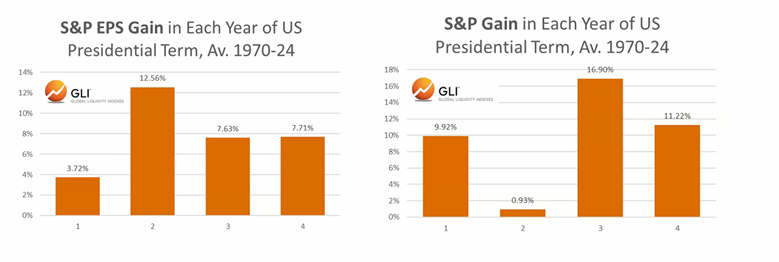
In our 2026 Outlook, we highlighted the following chart from GLI as one of the most important considerations for equity returns this year:
Source: GLI, as of January 2026
What this chart shows is that the second year of the four-year Presidential cycle, or the midterm year, typically coincides with the best earnings growth but the worst equity returns of the four-year cycle.
2026, after a strong middle, is looking to shape up like a typical midterm election year of softer returns but strong earnings: S&P 500 returns have faded in the past month, with the index now up just 5% for the year vs. a peak of 15% in October, all while earnings growth has been extraordinarily strong, tracking at 36% growth YoY.
The good news, and the seed that is sown for next year, is that after a tough second year of the election cycle, the third year tends to be the best year for S&P 500 returns, as the index is poised for a rebound. Of course, if the S&P 500 were to rally sharply into year end, there likely would be less room for upside into 2027, while further weakness into year end (potentially due to tax loss selling), would likely set up for an even better 2027.
Seed #2: One Side of the Institutional Positioning Boat
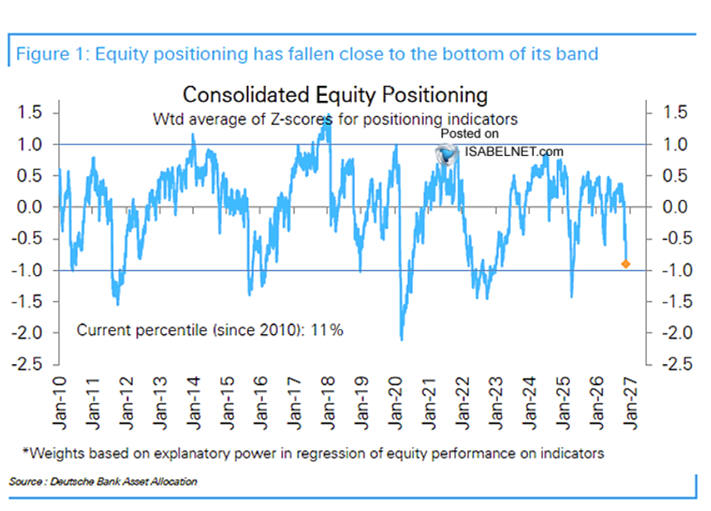
More good news from the recent market volatility is that it has resulted in a meaningful reset in positioning for institutional investors, which are now underweight the market.
The chart below from Deutsche Bank shows how positioning has fallen to the 11th percentile (which means only 11% of the time in the last 16 years were investors more underweight this market). Positioning could go lower, as it did in 2020, 2022, and 2025, but importantly, when positioning did get washed out these years, it coincided with major lows in the indices. Markets rallied in the subsequent periods, despite plenty of fear narratives and “reasons” for stocks to struggle (COVID fears in 2020, recession fears in 2023, and tariff fears in 2025).
Source: Deutsche Bank via Isabelnet, as of 11-23-26
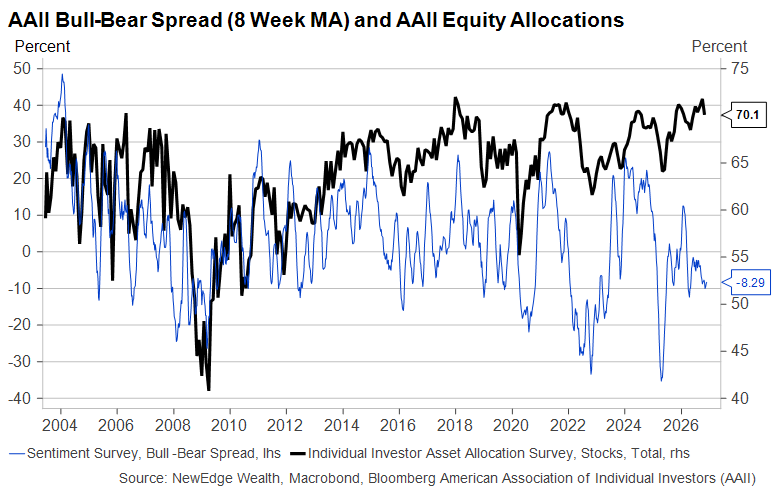
One caveat to this positive seed is that retail investors remain “all in” on equities, with surveys like AAII showing equity allocations have remained near multi-year highs (compared to 2020, 2022, and 2025 when they dropped materially).
As of 11-27-26
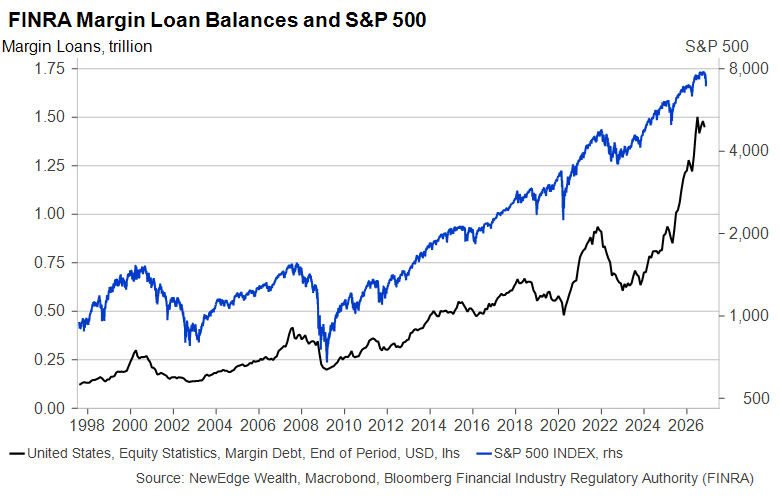
One thing to watch for retail sentiment is the November update of retail margin loan balances (as measured by FINRA). We typically see margin loan balances fall (growth go negative) at major lows when investors reduce leveraged exposure to equities due to fear or forced margin calls. As of October, FINRA margin loans still grew 11% over the prior 6 months.
S&P 500 data as of 11-27-26, FINRA data as of 10-29-2026
Seed #3: Valuation Reset (For a Reason)
The last seed of good news is that 2026’s lower returns have resulted in a meaningful reset in valuations for many portions of the equity market, with the overall S&P 500 trading at 17x forward earnings vs. 23x at the peak in 2025.
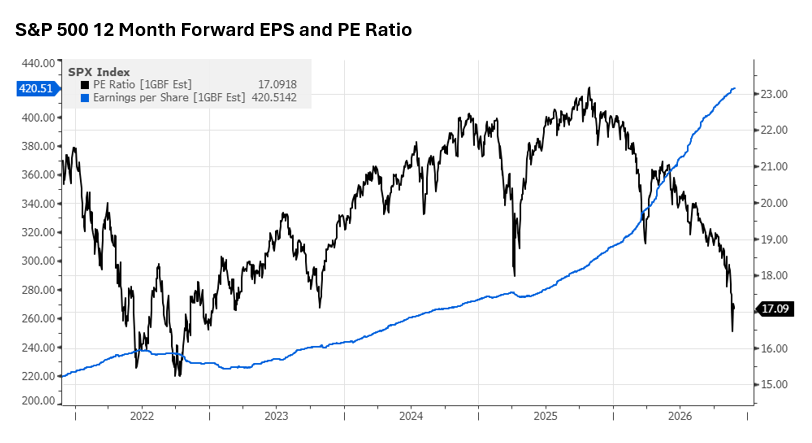
Source: Bloomberg, NewEdge Wealth, as of 11-27-26
But just as Brand New’s “Sowing Season (Yeah)” is about how something great can happen at the same time as something “completely awful,” we think it is important to interpret this valuation not necessarily as “cheap,” but as a message about future earnings expectations.
Simply put, we think that lower valuations are reflecting that earnings growth is going to slow down in 2027 (no shock here given the 36% growth in 2026) and signaling that estimates are likely to be cut in the coming quarters.
The Street sees no end in sight to strong earnings growth, with forecasts for S&P 500 EPS growth at 15% for both 2027 and 2028.
So why is there risk to these forecasts?
Because the equity prices are telling us there is.
Consider that the source of 2026’s extraordinary 36% EPS growth is largely thanks to 150% EPS growth in the S&P 500’s largest industry group, Semiconductors (which peaked at an 18% weight and have now fallen to a 13.5% weight given their 40% drop from their June highs). Looking forward, Semiconductors are forecasted to deliver 50% EPS growth in 2027 and another 30% EPS growth in 2028.
But the weakness in semiconductor stocks in the past 5 months has resulted in the group trading at a mere 13x forward earnings. Given semiconductors remain a cyclical industry group (meaning they are prone to boom bust cycles in earnings), a falling and low valuation on strong earnings is the market signaling that it expects earnings to peak and subsequently fall.
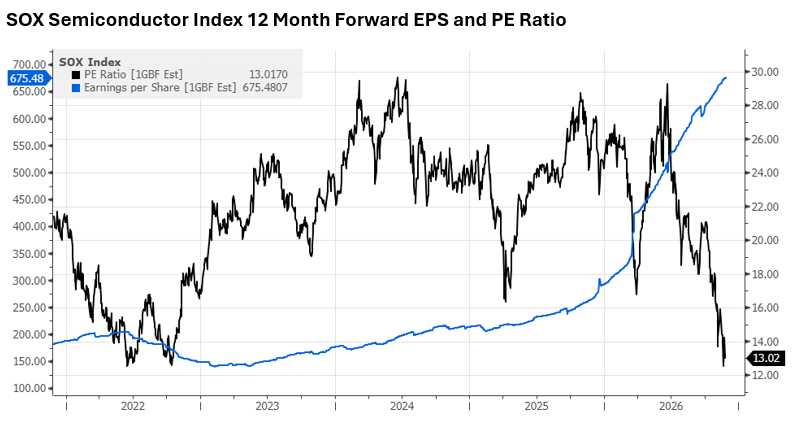
Source: Bloomberg, NewEdge Wealth, as of 11-27-26
Adam Parker of Trivariate Research ran this analysis and showed that “on average, over the previous sixteen times the Semiconductor price-to-forward earnings multiples have contracted this much, net income growth expectations for the industry were lowered by 20% within 3-to-6-months.”
We are firm believers, and repeaters, of the market truism that “price leads data,” meaning the stock prices will drop before the earnings estimates are cut, just as the stock prices will climb before the earnings estimates are raised.
We see the prospect of earnings estimate cuts as a source of volatility in the medium term (noting markets have become oversold enough to bounce in the short term), as we typically see markets react poorly to the first estimate cuts at the start of an earnings revision downcycle.
So, the good news is that valuations have reset, but the bad news is that earnings have not begun to be reset yet. Markets will bottom long before the estimate cutting is complete, but typically not before the estimate cutting has even started. We must balance this market message about fundamentals with the other “seeds” about seasonality and positioning, which could spur a rebound in 2027.
Conclusion: “Take All That You Have and Turn it Into Something You Were Missing”
As we enter these final weeks of the rather “interesting” 2026, we must appreciate these seeds of seasonality, positioning, and valuations as potential positives for 2027, mostly if dynamics like earnings estimate cuts cause more cautious market narratives. These seeds, along with our disciplined application of both technical and fundamental analysis, can help us (you) “Keep your head when all about you are losing theirs.”
And with that, we leave you with Kipling’s If-, a calm “kick in the seat” to carry us into year end.
If-
Rudyard Kipling
If you can keep your head when all about you
Are losing theirs and blaming it on you,
If you can trust yourself when all men doubt you,
But make allowance for their doubting too;
If you can wait and not be tired by waiting,
Or being lied about, don’t deal in lies,
Or being hated, don’t give way to hating,
And yet don’t look too good, nor talk too wise:
If you can dream—and not make dreams your master;
If you can think—and not make thoughts your aim;
If you can meet with Triumph and Disaster
And treat those two impostors just the same;
If you can bear to hear the truth you’ve spoken
Twisted by knaves to make a trap for fools,
Or watch the things you gave your life to, broken,
And stoop and build ’em up with worn-out tools:
If you can make one heap of all your winnings
And risk it on one turn of pitch-and-toss,
And lose, and start again at your beginnings
And never breathe a word about your loss;
If you can force your heart and nerve and sinew
To serve your turn long after they are gone,
And so hold on when there is nothing in you
Except the Will which says to them: ‘Hold on!’
If you can talk with crowds and keep your virtue,
Or walk with Kings—nor lose the common touch,
If neither foes nor loving friends can hurt you,
If all men count with you, but none too much;
If you can fill the unforgiving minute
With sixty seconds’ worth of distance run,
Yours is the Earth and everything that’s in it,
And—which is more—you’ll be a Man, my son!
IMPORTANT DISCLOSURES
The views and opinions included in these materials belong to their author and do not necessarily reflect the views and opinions of NewEdge Capital Group, LLC.
This information is general in nature and has been prepared solely for informational and educational purposes and does not constitute an offer or a recommendation to buy or sell any particular security or to adopt any specific investment strategy.
NewEdge and its affiliates do not render advice on legal, tax and/or tax accounting matters. You should consult your personal tax and/or legal advisor to learn about any potential tax or other implications that may result from acting on a particular recommendation.
The trademarks and service marks contained herein are the property of their respective owners. Unless otherwise specifically indicated, all information with respect to any third party not affiliated with NewEdge has been provided by, and is the sole responsibility of, such third party and has not been independently verified by NewEdge, its affiliates or any other independent third party. No representation is given with respect to its accuracy or completeness, and such information and opinions may change without notice.
Investing involves risk, including possible loss of principal. Past performance is no guarantee of future results.
Any forward-looking statements or forecasts are based on assumptions and actual results are expected to vary from any such statements or forecasts. No assurance can be given that investment objectives or target returns will be achieved. Future returns may be higher or lower than the estimates presented herein.
An investment cannot be made directly in an index. Indices are unmanaged and have no fees or expenses. You can obtain information about many indices online at a variety of sources including: https://www.sec.gov/answers/indices.htm.
All data is subject to change without notice.
© 2026 NewEdge Capital Group, LLC
