


Introduction: I’m Sure You Must Have a Lot Of Questions
Children of the 1970s and 1980s may remember where they were the first time they saw Tron, the film that showed audiences what the future of cinema would look like. While its state-of-the-art computer animation looks almost comical by today’s standards, its core theme of humanity’s ever-changing interaction with technology has helped it endure long enough to spawn sequels and major theme park rides.
2010’s Tron: Legacy, on which the Disney coaster is based, is perhaps most famous for its groundbreaking Daft Punk score. Arguably the best track from the album, “The Game Has Changed”, conveys momentum and danger, the perfect background track for making long trips in the family minivan feel like Light Cycle races on The Grid.
“The Game Has Changed” also creates appropriate atmospherics for the investment experience of 2026, with stocks trading on relatively narrow earnings momentum and bonds flashing danger signs. The abrupt rise in global interest rates has changed the game for investors, and today’s piece will highlight the opportunities and the risks we see in bond markets today…with quotes from Tron: Legacy to light the way. In short, while we expect yields to remain in an uptrend for now, their current level represents an attractive entry point for long-term investors.
Reminder: Why Have Rates Risen?
“Change the scheme, alter the mood.”
Long-term interest rates are at their highest level in decades in the U.S. and around the world, while the 40-year downtrend in yields that persisted from 1982-2022 has distinctly ended. We’ve been writing lately about why this is happening, but this graph summarizes it nicely. The bulk of the increase in the nominal 10-year yield (over both the past five years and the past seven months) has come from a rise in the 10-year real yield rather than from long-run inflation expectations moving higher:
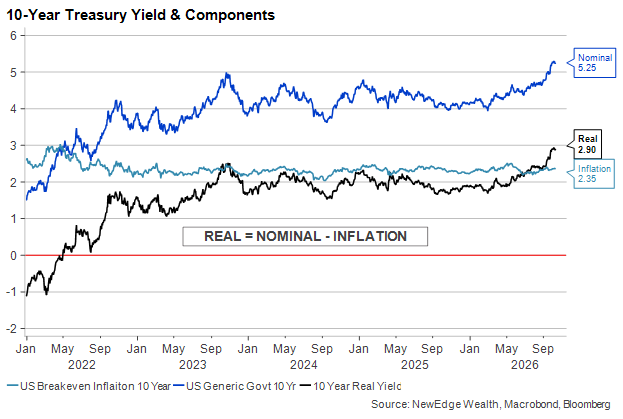
As of 10/9/26
Inflation has accelerated in 2026, mainly due to energy, but we see strong investment-led economic growth as the primary source of upward pressure on interest rates, and the inflation-linked bond market (which trades on inflation-adjusted yields) supports that view.
Despite the rise in real yields, however, financial conditions have remained loose, as exemplified by durably high equity market valuations and, until recently, historically tight corporate bond spreads. Risk aversion among investors often leads them to bid up bond prices, but it has been in short supply of late despite acute policy uncertainty and geopolitical strife. Resilience in major equity indices and powerful corporate earnings growth is a key reason that uncertainty, strife, and even softer economic data has not sparked a “flight to safety” bid for bonds.
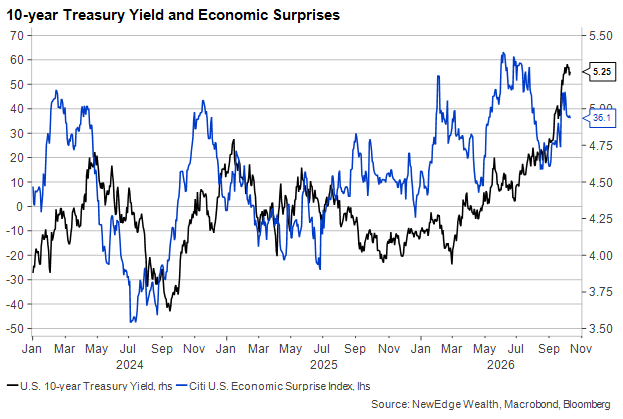
As of 10/9/26
The upside surprises to economic growth have come mainly from capital spending on Artificial Intelligence and consumer spending fueled by the rise in financial asset prices that A.I. spending has supported. Higher interest rates partly reflect higher demand for capital needed to build out the A.I. boom.
We admit that Treasuries have not been helped by ineffective verbal and financial market interventions from U.S. Treasury Secretary Bessent or by Federal Reserve Chair Warsh’s refusal to tell markets where monetary policy may be headed. Those errors have likely caused investors to demand somewhat higher yields than they would based simply on their expected path of rates. But as this graph shows, rising rates are far from a U.S.-only story:
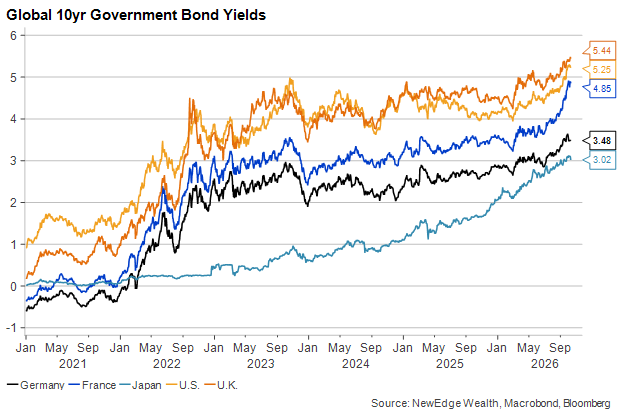
As of 10/9/26
The notable rise in government borrowing rates in Europe and Asia indicate some concern about government debt sustainability in the U.S. and around the world. While certainly not new, fiscal concerns become more important to investors when they have attractive investment options (e.g., the A.I. buildout) outside of lending to, for example, the governments of France or Japan. Addressing these concerns is politically difficult but will be mandatory over the medium-term for governments that hope to keep public and private borrowing costs contained.
Opportunities in Bond Markets
“Out there is a new world! Out there is our victory! Out there is our destiny!”
Rising interest rates mean falling bond prices, as any investor who has looked at his or her third quarter statement knows. Even accounting for the income bonds provide, their total returns across most categories have been negative this year:
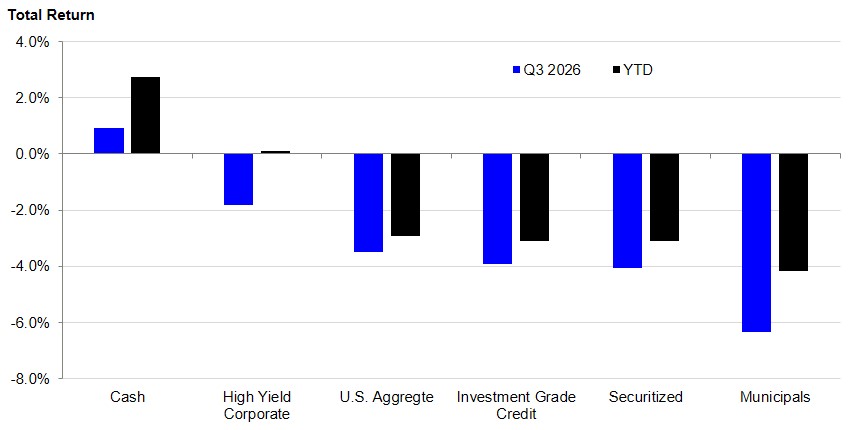
Source: Bloomberg, as of 9/30/26
But opportunity often arises from losses. Rising rates today don’t mean immediately better returns on bonds, but they do tend to lead to higher returns in the future, as shown on this graph. It shows that ten-year taxable bond returns are driven almost entirely by the level of interest rates at the start of the observation window:
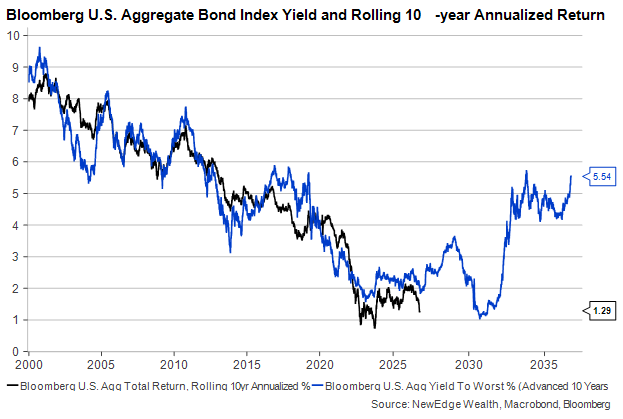
As of 10/7/26
Treasuries and corporates look more attractive today than they did to start the year, purely due to the rise in rates/drop in prices. But municipal bonds offer taxable investors a particularly attractive entry point: their highest yields since 2002 outside of a brief crisis in 2008. This means that even if yields remain in their current uptrend, investors have more cushion from the higher yields to protect against price losses on the bonds:
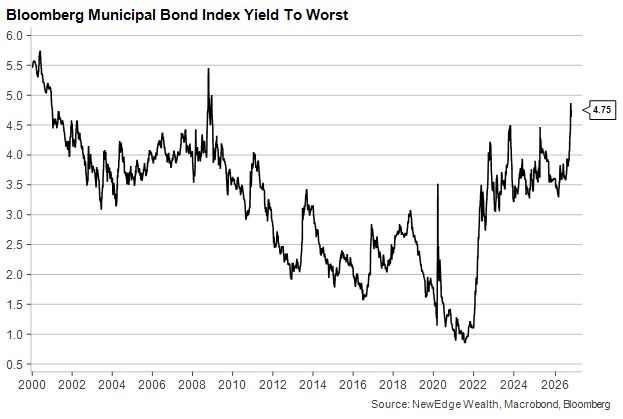
As of 10/7/26
Municipals tend to be most challenged during periods of rising rates as individual investors (who benefit most from tax-exempt coupon payments) shy away from fixed income when times are tough. Higher issuance levels have also created new supply at a time when demand has wavered. We see an opportunity to zig while others are zagging, increasing allocations to municipal bonds given their historically high yield relative to other markets:
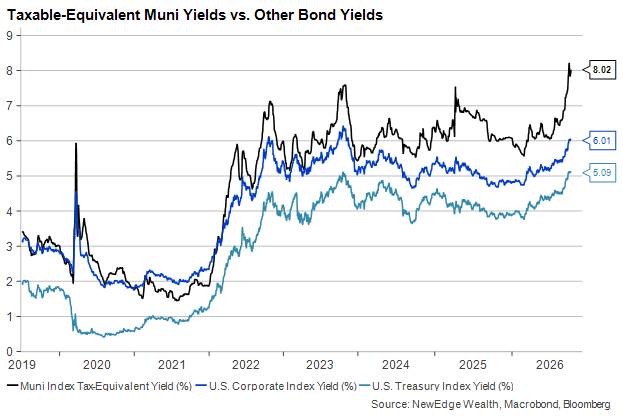
As of 10/7/26
Rebalancing Back Into Bonds
“I realize that our alliance is, at times, uneasy. But always necessary.”
Bonds took a reputational hit in 2022 when they failed to shield investors from an equity bear market. In fact, bonds performed worse on a risk-adjusted basis than stocks that year, because they sat closer to the blast zone of skyrocketing inflation and interest rates.
Bond returns are nowhere near as poor in 2026 as they were in 2022, but stocks are still outperforming. Rising rates have undoubtedly hurt several rate-sensitive equity sectors like Utilities and Homebuilders, but A.I. earnings momentum via higher capex investment has kept prices supported as expectations for higher profits offset lower valuations. Despite these lower valuations, the yield on the Bloomberg U.S. Aggregate Bond Index has have shot above the S&P500 earnings yield for the first time since the Tech Bubble at the start of this century. This chart shows that today’s relative valuations hold predictive power for long-term relative returns:
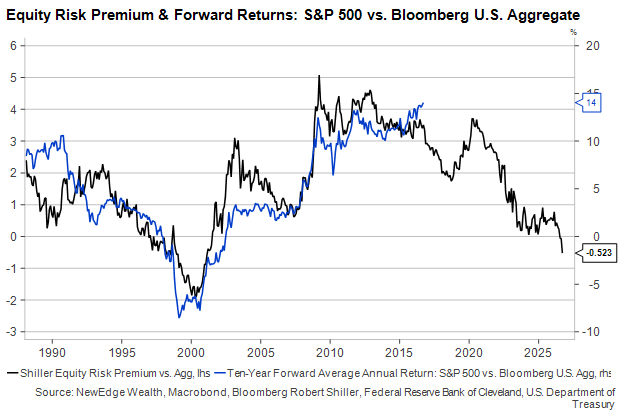
As of 9/30/26
This chart should tell long-term investors that if their portfolios have become heavily overweight stocks in recent years, now may be a good time to rebalance. Interest rates may rise further in the near term, but history tells us to expect a smaller gap between stocks and bond performance over the next ten years.
Cracks in the Credit Market: Jump Over or Jump In?
“The cycles haven’t been kind, have they?”
When interest rates rise as much as they have this year, stress tends to emerge in one or more sectors of the economy and financial markets. In 2023, the cumulative effect of rate hikes led to the high-profile failure of Silicon Valley Bank and several of its peers. The larger economy avoided a contraction, however, and parts of the bond market that normally come under stress when rates rise abruptly emerged relatively unscathed.
Now rates are rising again, and we are once again seeing worrisome signs in the lowest-rated parts of the corporate credit market. CCC-rated bonds, which have a far higher average default rate compared to higher-rated corporate bonds, are already trading at spreads to Treasuries comparable to their widest levels during the last tightening cycle.
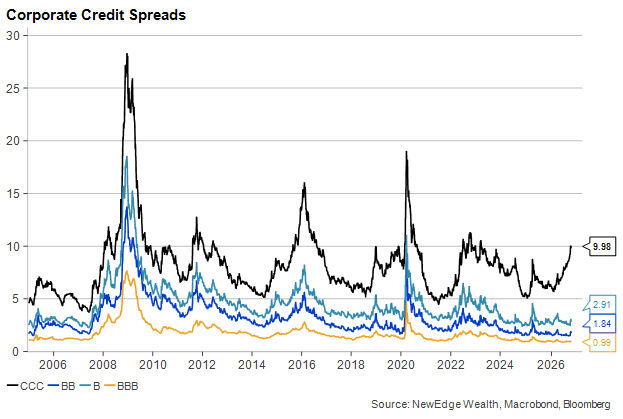
As of 10/7/26
In higher-rated parts of the corporate bond market, however, the stress is still minimal. The gap between the yields on BB-rated bonds, which fall just below investment grade, and BBB-rated yields is still well below average and only about half of its 2022 peak, let alone the 2008 blowout:
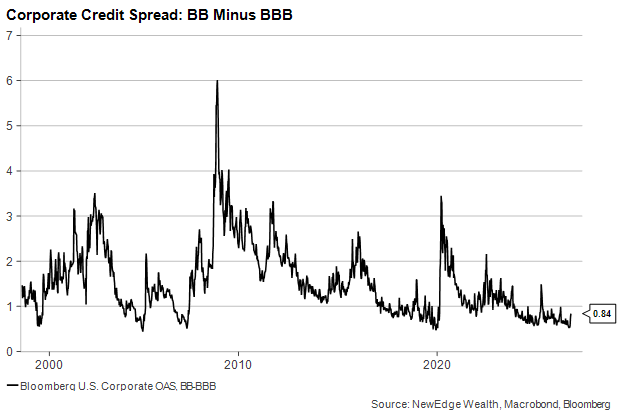
As of 10/7/26
We may soon reach a moment when credit risk is paying investors more, but getting there may involve a period of extremely poor returns, even in CCC-rated credit where yields have already shot up. For now, we are electing to be more defensive, jumping over the cracks in the credit markets rather than plunging into them.
Conclusion: Clip Coupons, Don’t Hope For a Rally
“It’s amazing how productive doing nothing can be.”
In our asset allocation framework, bonds are primarily a source of income for investors while stocks and alternatives provide the bulk of long-term growth. Because we do not foresee a return to the forty-year bond bull market anytime soon, we evaluate bonds’ attractiveness primarily based on their yield and not their potential for significant price appreciation.
For bonds to produce total returns well above their yields over the next year, long-term rates would need to fall. Most of the ways we can imagine this happening are bad. Rates could fall amid a sustained Fed tightening cycle, but this would likely come at the expense of higher short-term yields. And a genuine crisis in markets – some failure in the A.I. narrative, for example – would likely take down risk asset prices and lead to flights to safety and falling rates.
Of course, we aren’t rooting for a downside scenario just to squeeze higher returns out of bonds, because we don’t need to. In the world of Tron, we are told that the only way to win is not to play. But in the world of bonds, where the game has changed, it’s just the opposite. Thanks to the high yields being offered by issuers with historically low default rates, the easiest way for long-term investors to “lose” is by not owning enough.
IMPORTANT DISCLOSURES
The views and opinions included in these materials belong to their author and do not necessarily reflect the views and opinions of NewEdge Capital Group, LLC.
This information is general in nature and has been prepared solely for informational and educational purposes and does not constitute an offer or a recommendation to buy or sell any particular security or to adopt any specific investment strategy.
NewEdge and its affiliates do not render advice on legal, tax and/or tax accounting matters. You should consult your personal tax and/or legal advisor to learn about any potential tax or other implications that may result from acting on a particular recommendation.
The trademarks and service marks contained herein are the property of their respective owners. Unless otherwise specifically indicated, all information with respect to any third party not affiliated with NewEdge has been provided by, and is the sole responsibility of, such third party and has not been independently verified by NewEdge, its affiliates or any other independent third party. No representation is given with respect to its accuracy or completeness, and such information and opinions may change without notice.
Investing involves risk, including possible loss of principal. Past performance is no guarantee of future results.
Any forward-looking statements or forecasts are based on assumptions and actual results are expected to vary from any such statements or forecasts. No assurance can be given that investment objectives or target returns will be achieved. Future returns may be higher or lower than the estimates presented herein.
An investment cannot be made directly in an index. Indices are unmanaged and have no fees or expenses. You can obtain information about many indices online at a variety of sources including: https://www.sec.gov/answers/indices.htm.
All data is subject to change without notice.
© 2026 NewEdge Capital Group, LLC

