


“The best time to plant a tree was 20 years ago. The second-best time is now.” – Chinese proverb
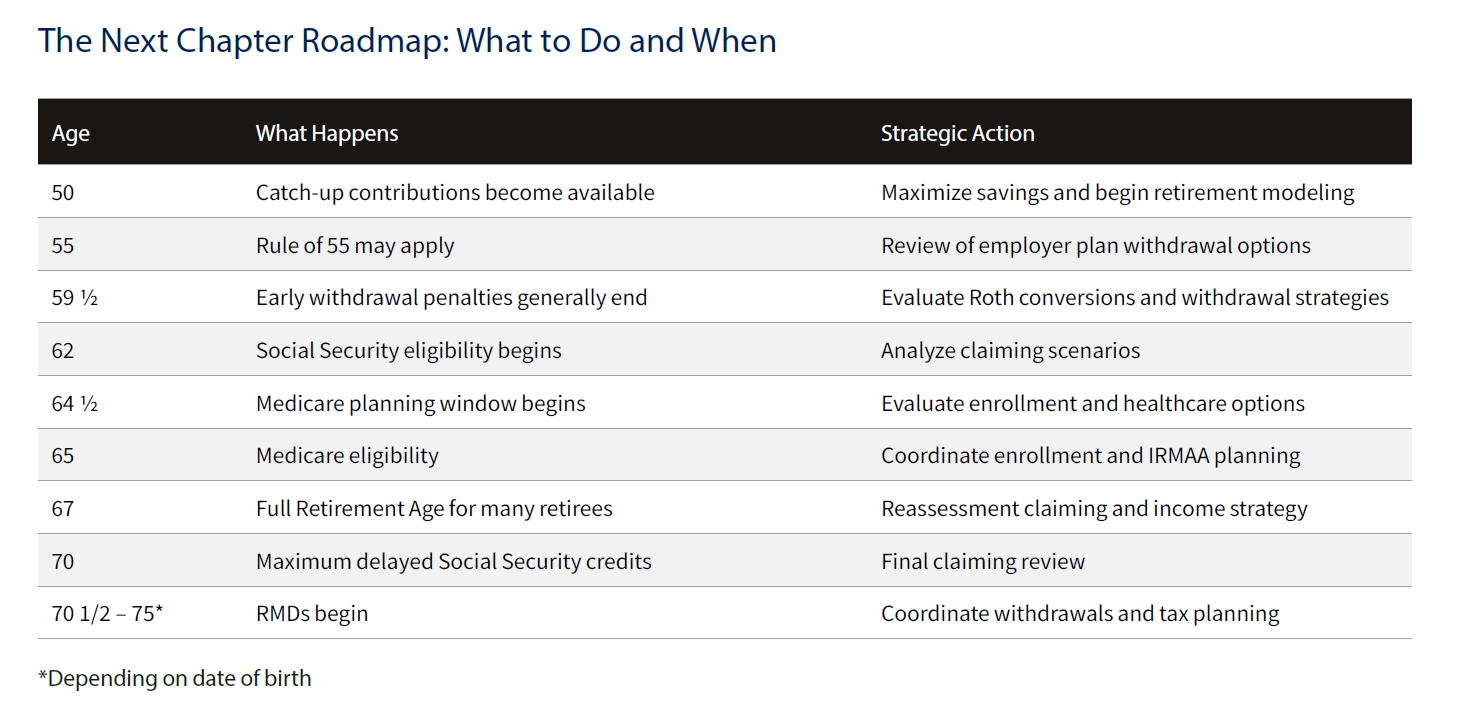
For many successful individuals and families, the years between age 50 and the beginning of required minimum distributions (ages varying between 70½ and 75) represent a pivotal phase of financial planning. Whether you continue building a business, pursue new professional opportunities, transition into retirement gradually, or simply seek greater financial flexibility, the decisions made during this period can have a lasting impact on your wealth, tax efficiency, and legacy. This guide highlights the key planning milestones and opportunities by age, providing a practical framework to help you make informed decisions, preserve flexibility, and align your financial resources with the goals that matter most.
Age 50
“You think you’ve seen the sun, but you ain’t seen it shine” – The Best Is Yet to Come, Frank Sinatra (1964)
The Best Is Yet to Come captures the spirit of retirement planning at age 50: the next stage of life can be immensely rewarding, provided the proper groundwork is laid in advance.
Beginning in the calendar year an individual turns 50, they become eligible to make catch-up contributions to IRAs and employer-sponsored retirement plans. For 2026, catch-up limits on top of standard contributions limits are set at $8,000 ($11,250 for employees aged 60-63) for 401(k), 403(b), and most governmental 457(b) plans and $1,100 for traditional and Roth IRAs. This creates additional opportunities to build tax-advantaged wealth in years that often coincide with peak earning power, making them particularly valuable for maximizing savings while implementing more sophisticated strategies.
Note: Individuals 50 and older who earned > $150,000 in FICA wages in the prior year must make catch-up contributions to employer-sponsored plans on a Roth basis.
Strategic Action:
Speak to a NewEdge Wealth advisor about developing your personalized comprehensive retirement roadmap and ask whether these catch-up strategies can support your retirement goals.
Age 55
“Here comes the sun, and I say, it’s all right” – Here Comes the Sun, The Beatles (1969)
Here Comes the Sun by The Beatles reflects the outlook at age 55, when retirement planning often shifts from long-term accumulation to actionable transition planning. A key planning provision at this stage is the “Rule of 55.” Individuals who separate from service during or after the year they turn 55 may be able to access assets in their current employer-sponsored retirement plan without the 10% early withdrawal penalty. Ordinary income taxes still apply, and eligibility depends on plan rules and timing of separation.
This provision can make it “feel [like] that ice is slowly melting” by providing important liquidity in the early retirement window but must be structured in advance to be effectively integrated into broader income and withdrawal planning.
Strategic Action:
Review your employer-sponsored retirement plan with a NewEdge Wealth advisor to determine Rule of 55 eligibility and incorporate it into your retirement income and transition strategy prior to separation from service.
Age 59½
“Sun is shinin’ in the sky, there ain’t a cloud in sight” – Mr. Blue Sky, Electric Light Orchestra (1977)
By age 59½, Mr. Blue Sky is no longer hiding away. This milestone generally eliminates the 10% early withdrawal penalty on distributions from qualified retirement accounts. While retirement may still be years away, this milestone can unlock new planning opportunities that were previously unavailable.
Strategic Action – With the help of your advisor:
Leverage the NewEdge Wealth Strategy team in conjunction with your advisor to:
- Establish a coordinated withdrawal strategy that determines which accounts should be accessed first, which assets should remain invested, and how distributions may affect future tax liabilities.
- Evaluate Roth conversion strategies before required minimum distributions begin and to position retirement assets in a manner that supports both long-term income needs and legacy objectives.
Age 62
“Should I stay or should I go now?” – Should I Stay or Should I Go, The Clash (1982)
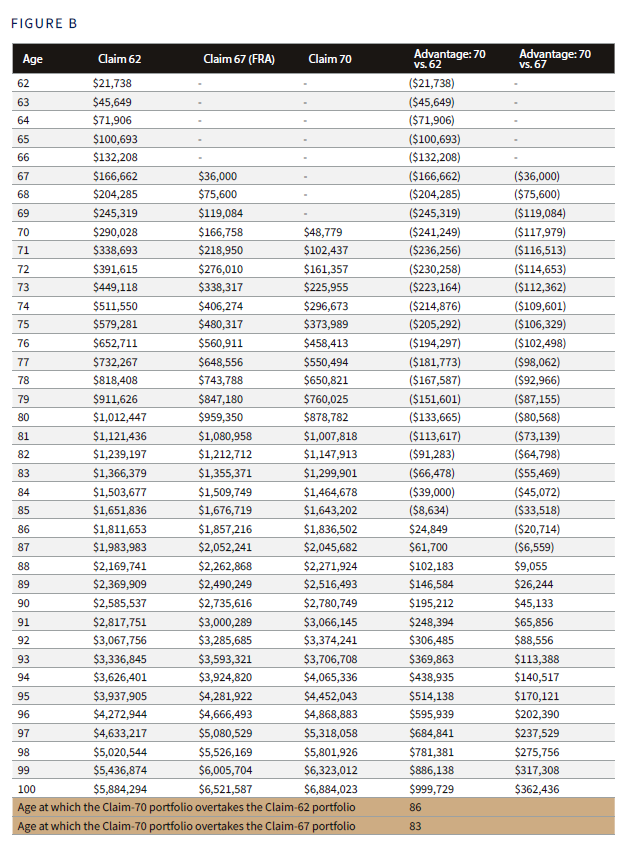
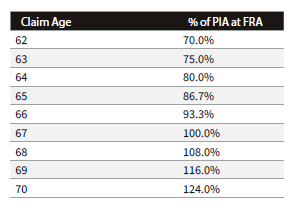
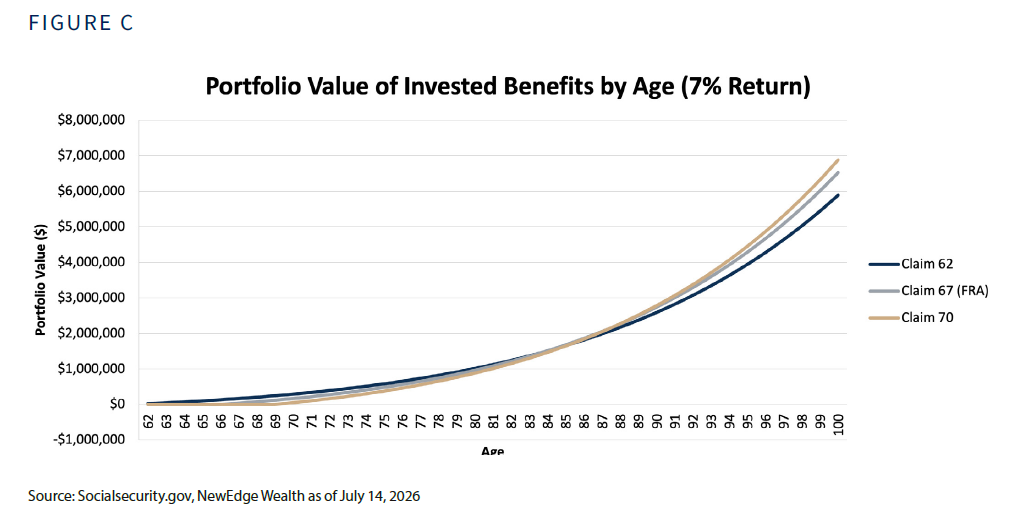
Much like the song’s central question, reaching age 62 presents retirees with a consequential decision in retirement planning: begin collecting Social Security benefits early or wait until “Full Retirement Age” or age 70 for a potentially larger future benefit. If collections begin at age 62, benefits will be reduced due to early claiming. The answer depends primarily on whether the funds are needed to support current lifestyle or cash flow requirements and life expectancy.
Strategic Action – With the help of your advisor:
- Know your Full Retirement Age.
- Understand your projected reduction in benefits and the implications of collecting early.
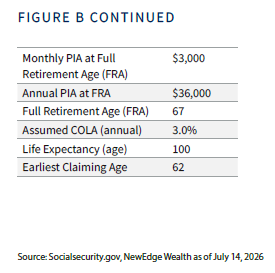
- Compute the effect of early or late retirement and consult figures A, B and C below for an example.
Age 64½
“Ready or not, here I come, you can’t hide” – Ready or Not, Fugees (1992)
Approximately six months before becoming eligible for Medicare, healthcare planning should become an active part of the retirement conversation. This is an important planning window to evaluate enrollment requirements, coverage options, projected healthcare expenses, and the role healthcare costs will play within the broader retirement plan.
For higher-income retirees, Medicare planning extends beyond selecting coverage. Medicare premiums may be subject to Income-Related Monthly Adjustment Amounts (IRMAA), meaning higher levels of taxable income can result in higher premiums. Critically, IRMAA is determined using modified adjusted gross income from two years prior; the tax return filed at age 63 drives the premiums paid at 65. Decisions surrounding retirement income, Roth conversions, capital gains, and other tax planning strategies may therefore have implications that extend beyond the tax return itself.
Strategic Action – With the help of your advisor:
- Understand IRMAA.
- Build a healthcare strategy that coordinates medical expenses, coverage, and retirement income, with a focus on managing taxable income in the years around enrollment.
Age 65
“This gray hair don’t mean a thing” – I Don’t Need Your Rockin’ Chair, George Jones (1992)
Everyone hopes to “still feel like a new Corvette” at age 65, but it is essential to understand the appropriate Medicare enrollment steps at this stage to avoid paying penalties or inadvertently causing gaps in coverage. If at least one spouse in a married couple is still working and is covered under a qualifying group medical insurance plan (generally employers with 20+ employees) that covers them both, then they are not required to enroll in Medicare at age 65. They have up to eight months after their eventual separation from service or their coverage ends, whichever comes first, to enroll in Part B Medicare. If someone is not covered by a qualifying plan, at age 65 they must enroll in both Parts A and B Medicare to avoid penalties and gaps in coverage. Failure to enroll on time may result in permanent premium penalties. The enrollment window spans the three months before the birth month, the birth month, and the three months after the birth month.
Notes:
- Approximately 99% of Medicare beneficiaries are not subject to Part A premiums.
- Virtually anyone receiving Social Security at least four months before turning 65 is exempt from Part A premiums and will be automatically enrolled in Parts A & B at age 65.
- There is no automatic Part A or B enrollment for someone who is not yet receiving Social Security.
- Part B carries a premium.
- COBRA is not considered a qualifying group plan.
Strategic Action – With the help of your advisor:
- Coordinate enrollment with your income and tax strategy, including supplemental and drug coverage and future IRMAA exposure.
Age 67
“The waiting is the hardest part” – The Waiting, Tom Petty and the Heartbreakers (1981)
For many retirees, age 67 represents “Full Retirement Age” (FRA) for Social Security purposes. At this point, benefits may be claimed without any reduction for early filing, and the Social Security earnings test no longer applies. For those who continue working, this milestone creates additional flexibility because benefits may be received regardless of earned income. For some, “the waiting is the hardest part”, but delaying retirement until the age of 70 to increase benefits remains an option.
Strategic Action – With the help of your advisor:
Determine whether claiming at FRA or delaying to age 70 better supports your income, tax, and legacy objectives.
Age 70
“Go on, take the money and run” – Take the Money and Run, Steve Miller Band (1976)
Age 70 represents the final Social Security claiming milestone. Delayed retirement credits cease accruing at this age, meaning there is no financial advantage to postponing benefits beyond age 70. Delaying claiming from FRA until age 70 will lead to the receipt of the maximum available monthly benefit, creating a larger source of guaranteed lifetime income and, in many cases, increasing survivor benefits available to a spouse.
Strategic Action – With the help of you advisor:
- Understand who can get survivor benefits and what beneficiaries can get.
- Integrate Social Security with portfolio withdrawals and tax planning to support sustainable, tax-efficient retirement cash flow and legacy objectives.
Age 70½, 72, 73, or 75 (depending on date of birth)
“Time has come today…can’t put it off another day” – Time Has Come Today, The Chambers Brothers (1967)
Required Minimum Distributions (RMDs) begin for tax-deferred retirement accounts at in the year in which an individual reaches their respective RMDs age. The first RMD can be delayed until April 1 of the year following the year the applicable RMD age is reached. However, delaying the first distribution requires taking two taxable RMDs in the same calendar year, which may increase taxable income and potentially push the retiree into a higher tax bracket. After the first year, RMDs must be taken annually by December 31.
RMD ages by date of birth (updated under the SECURE 2.0 act)
- Before July 1, 1949 – RMDs at 70½
- July 1, 1949, through December 31, 1950 – RMDs at 72
- January 1, 1951, through December 31, 1959 – RMDs at 73
- On or after January 1, 1960 – RMDs at 75
Note: An individual with multiple IRAs must calculate the RMD for each account but can take the total RMD amount from any of the accounts. A similar rule applies to individuals with multiple 403(b) tax-sheltered annuities. An individual with multiple 401(k) or 457(b) plans must take an RMD from each account.
Strategic Action – With the help of you advisor:
- Understand Required Minimum Distributions (RMDs).
- Build a tax-efficient withdrawal strategy that satisfies RMDs while integrating charitable giving and legacy objectives (ex. which IRA(s) to withdraw from).
Conclusion
“The future depends on what you do today.” – Mahatma Gandhi
Successful planning extends well beyond reaching a particular age, it requires continuous evaluation as your financial circumstances, family dynamics, and the regulatory landscape evolve. While the milestones outlined in this guide provide a framework for action, the greatest value comes from integrating investment management, tax strategy, estate planning, risk management, and charitable giving into a coordinated plan. By anticipating key decisions before they become deadlines, you can position your wealth to support not only your future lifestyle, but also the legacy you intend to leave for future generations. We encourage you to review these action items regularly and work closely with your advisory team to ensure your plan remains aligned with your long-term vision.
Sources:
https://www.ssa.gov/benefits/retirement/planner/agereduction.html?mf_ct_campaign=msn-feed&utm
https://www.fidelity.com/learning-center/personal-finance/what-is-rule-of-55
https://www.schwab.com/learn/story/what-to-know-about-catch-up-contributions
https://www.cms.gov/newsroom/fact-sheets/2026-medicare-parts-b-premiums-deductibles
https://www.ssa.gov/faqs/en/questions/KA-01921.html
https://www.ssa.gov/OACT/COLA/RTeffect.html
https://www.ssa.gov/OACT/quickcalc/early_late.html#late
https://www.medicare.gov/basics/get-started-with-medicare/before-65
https://www.ssa.gov/survivor/eligibility
https://www.ssa.gov/survivor/amount
https://rmd-estimator.web.vanguard.com/
https://www.medicare.gov/publications/11579-medicare-costs.pdf
IMPORTANT DISCLOSURES
The views and opinions included in these materials belong to their author and do not necessarily reflect the views and opinions of NewEdge Capital Group, LLC.
This information is general in nature and has been prepared solely for informational and educational purposes and does not constitute an offer or a recommendation to buy or sell any particular security or to adopt any specific investment strategy.
NewEdge and its affiliates do not render advice on legal, tax and/or tax accounting matters. You should consult your personal tax and/or legal advisor to learn about any potential tax or other implications that may result from acting on a particular recommendation.
The trademarks and service marks contained herein are the property of their respective owners. Unless otherwise specifically indicated, all information with respect to any third party not affiliated with NewEdge has been provided by, and is the sole responsibility of, such third party and has not been independently verified by NewEdge, its affiliates or any other independent third party. No representation is given with respect to its accuracy or completeness, and such information and opinions may change without notice.
Investing involves risk, including possible loss of principal. Past performance is no guarantee of future results.
Any forward-looking statements or forecasts are based on assumptions and actual results are expected to vary from any such statements or forecasts. No assurance can be given that investment objectives or target returns will be achieved. Future returns may be higher or lower than the estimates presented herein.
An investment cannot be made directly in an index. Indices are unmanaged and have no fees or expenses. You can obtain information about many indices online at a variety of sources including: https://www.sec.gov/answers/indices.htm.
All data is subject to change without notice.
© 2026 NewEdge Capital Group, LLC

