


Introduction: Mourning a Legend
“Storms make trees take deeper roots.”
The world lost an icon this week when Dolly Parton passed away far too soon at the age of 80. Depending on what generation you belong to, you may know Dolly best for her talent, her wit, her generosity, or her amusement park. But as the outpouring of goodwill made clear over the past several days, the undeniable goodness of her life and work earned her virtually unanimous public approval, something vanishingly few people can claim to have these days.
We’d be lying if we claimed to have found an airtight connection between Dolly Parton and our topic in today’s Weekly Edge: U.S. policymakers, the economy, and the bond market. So, instead, we’ll use some of her most famous quotations to open each section of the piece. If nothing else, applying them to financial topics should show us how universally her wisdom held.
We last wrote about the Federal Reserve and interest rates at the end of July, and a lot has happened in a month. Recent remarks by both Treasury Secretary Scott Bessent and Fed Chair Kevin Warsh got the bond market’s attention and are worth weighing. Bonds offer their highest yields in decades, but we know many investors are worried that interest rates have further to climb (and bond prices further to fall) given the current bipartisan political preferences for stimulative fiscal and monetary policy.
The Bad News: The U.S. Treasury Can’t Bring Long-Term Rates Down
“It costs a lot of money to look this cheap.”
Treasury Secretary Bessent sent the bond market reeling, albeit temporarily, with his plan to increase so-called buyback operations, whereby the Treasury uses cash on hand to “buy back” some of its longer-term notes and bonds from willing sellers. While the practice is intended to ensure ample market liquidity, especially in older “off-the-run” issues, the line between ensuring liquidity and influencing prices can blur easily.
These operations, even if scaled up as Bessent described, are quite small relative to the size of the Treasury market. A few billion dollars of purchases cannot meaningfully move bond prices unless they signal a credible commitment to bring down long-term rates. To that end, there were reports in the financial press that the Treasury could use its nearly $1 trillion account held at the Fed, termed the Treasury General Account or “TGA”, to add more oomph to its expanded buyback operations. The TGA is intended to be used to make payments in an emergency like a disaster or an impending debt ceiling breach, and its use to buy back outstanding securities would be contested in court.
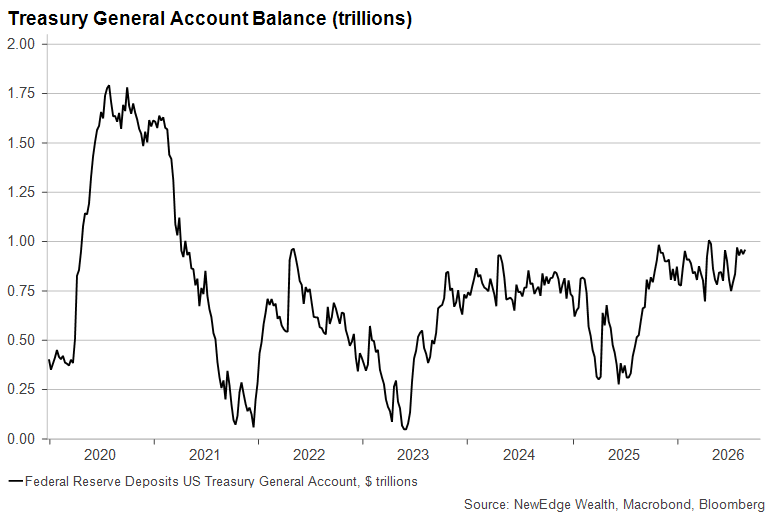
As of 8-28-26
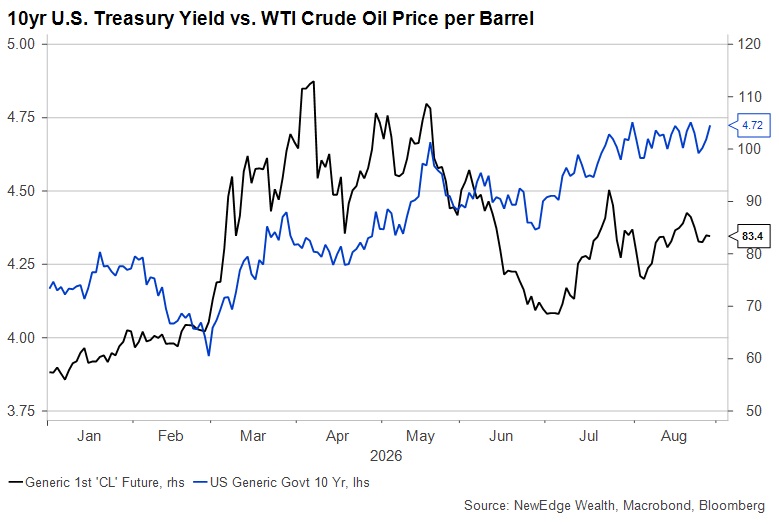
With the benefit of a few days of reflection, the bond market was not impressed by any of this, as it correctly (in our view) deemed these actions either ineffectual in the case of the expanded buybacks or unlikely in the case of the TGA drawdown. Yields remain in the same range they’ve been in for the past month, although the drop in the WTI crude oil price last week may have helped the 10-year yield come down slightly from its recent high:
As of 8/28/26
Higher oil prices in 2026 have meant higher inflation, which has translated into higher interest rates. But even geopolitics’ impact on rates tends to be limited and short-term in nature. The true driver of rates over the long term is the performance of the economy, as we’ll describe in the next section.
Worse News: Slowing the Economy May Be the Best Way to Bring Rates Down
“The way I see it, if you want the rainbow, you gotta put up with the rain!”
As of 8/28/26
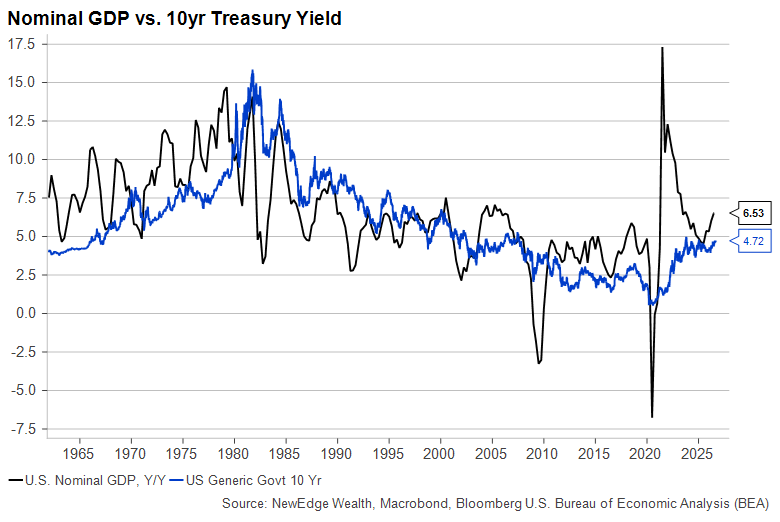
It turns out that nominal growth (which includes both real output and inflation) and nominal interest rates are closely related. Excluding the period surrounding the pandemic, nominal GDP growth has not been this high since the mid-2000s, which is also the last time the 10-year Treasury yield was this high. We do not view this as a coincidence.
The chart above also shows clearly that 10-year rates have generally been lower than nominal GDP growth for most of the past twenty years. One reason for this could be that the Fed has, for much of this period, been an “uneconomic buyer” of government debt as it expanded it balance sheet to suppress yields. Another could be investors’ collective belief until 2022 that short-term interest rates would remain close to zero in perpetuity and that high inflation would no longer be a problem.
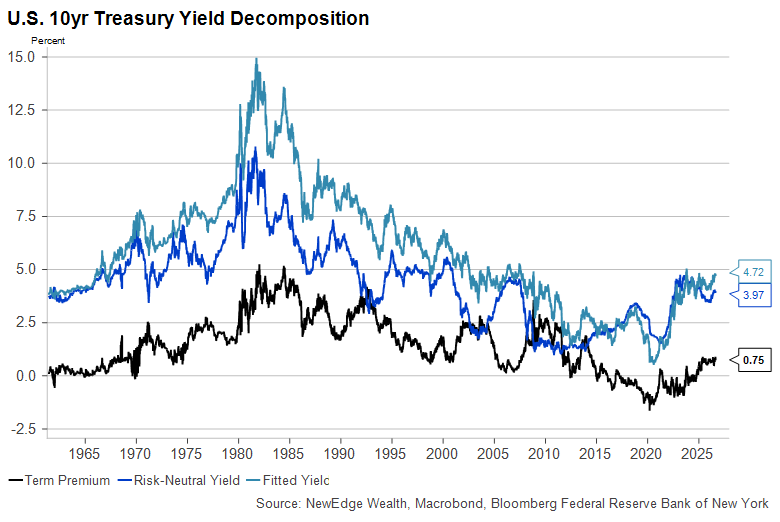
This next chart suggests that both explanations are valid. Expectations of lower short-term rates fell after the 2008 financial crisis as did the term premium, which is the extra yield investors demand to hold long-term securities:
As of 8/28/26
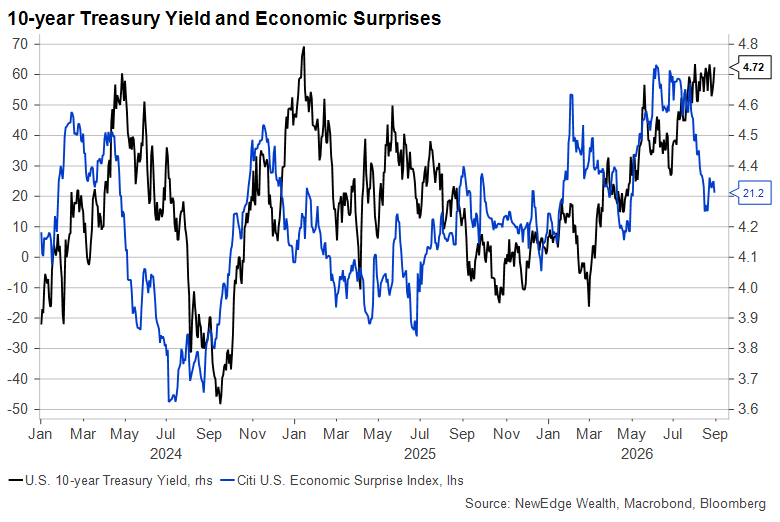
The Fed’s post-GFC strategy was to buy bonds to bring down the term premium while also keeping short-term rates fixed at zero, made possible by the low growth and low inflation economic backdrop. But in today’s period of high fiscal deficits and above-target inflation, easy monetary policy is likelier to push the 10-year yield higher than lower. Indeed, even the recent run of negative data surprises (shown by the recent drop in the blue line on the chart below) has failed to push it down:
As of 8/28/26
We think we know why. Most of the bad data has been limited to the housing and employment areas. With housing, the causal relationship with rates tends to point in the opposite direction: higher rates lead to poor construction and sales. And weaker hiring, while potentially a sign of an economic slowdown, may also signal that firms are able to produce more without needing more workers. In other words, their profit margins have widened.
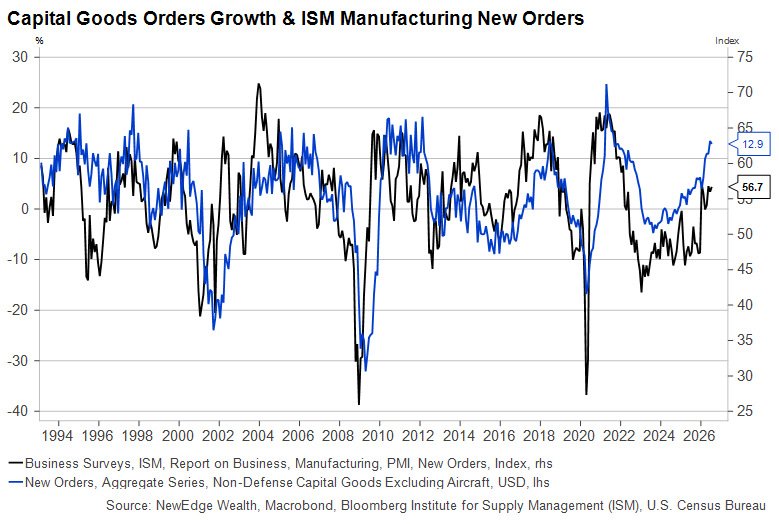
The broad softness in the data has not stopped analysts from revising corporate earnings estimates higher or stirred a “flight to safety” out of equities and into cash or bonds. That may be because categories of economic data that are more closely correlated with financial market behavior, including business surveys and capital goods orders, have been hot lately:
As of July 2026
The White House and Treasury do not want these leading indicators to turn lower, but a Federal Reserve facing persistently high inflation and few acute concerns about a dramatically slowing labor market may feel different. In our next section, we’ll consider Fed Chair Warsh’s public remarks this week on monetary policy and the role of the Fed.
Confusing News: The Fed Chair Still Won’t Tell Us What He’s Going to Do
“If you don’t like the road you’re walking, start paving another one.”
The Treasury and (of course) the White House have delivered most of the market-moving policy news over the past few weeks. But this week, investors’ calendars were blocked off (as they always are in late August) for the Fed Chair’s remarks at the annual Jackson Hole Economic Symposium. This year, the presence of a new Fed Chair made the event even more anticipated than usual.
Chair Warsh’s public approach in the opening months of his tenure has been to do little and say even less. In keeping with this practice, he provided characteristically few thoughts on how monetary policy might need to evolve in the near term to deal with above-target inflation. But he did close the speech with a frank assessment of inflation (too high and not improving meaningfully) and vaguely acknowledge the Fed might need to react to it: “We must be confident that underlying inflation is moving to our objective, clearly and at sufficient speed. Otherwise, we have work to do.”
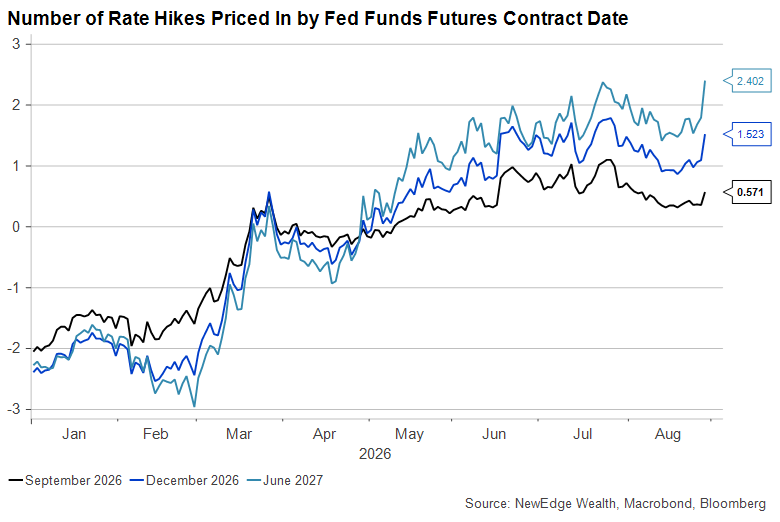
Prior to Warsh’s Jackson Hole speech, the market-implied probability of a rate hike at the Fed’s September 16th meeting has fallen to its lowest level of the summer. His speech took those odds up a little, but as this graph shows, the decision remains close to a coin toss in the eyes of investors:
As of 8/28/26
Employment and inflation data both came in softer in July, which may be sufficient to delay a rate hike for now. In addition, the rise in long-term interest rates, which Warsh has hinted he sees as the market doing the Fed’s tightening work for it, have held at high levels, as we pointed out above.
The one area of the economy that looks set to weaken is consumer spending, which we covered a few weeks ago. But tighter policy to bring inflation down could arguably be seen as helping address cost of living concerns. Even after Warsh’s remarks, saying what the Fed will do or should do in September remains as difficult a call as it was a month ago.
Conclusion
“We cannot direct the wind, but we can adjust the sails.”
In our description of what has brought interest rates back to cycle highs and what might be done to bring them back down, we’ve conspicuously avoided mentioning the federal debt or deficit. This is not because we’re ignoring the effect fiscal profligacy is having on the bond market. It’s simply an acknowledgment that there is currently no political will to tighten fiscal policy via tax increases or spending cuts. Monetary policy and incoming economic data are likely to be the only two durable influences on the bond market for the time being, perhaps with the occasional geopolitical shock thrown in.
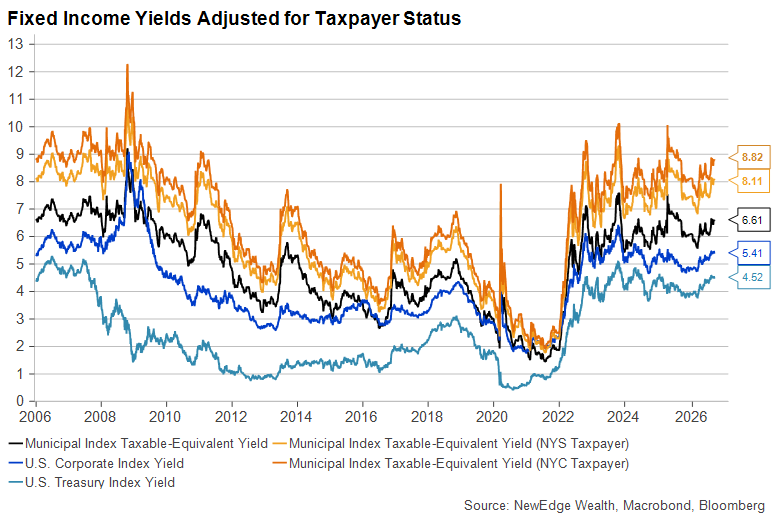
Short of an economic collapse, we do not expect bond yields to move dramatically lower in the near term, which offers investors a window of opportunity to access some of the highest yields in a generation. Those who live in high-tax areas should pay particular attention to this chart, which shows the benefit of moving from taxable to municipal bonds using an apples-to-apples taxable-equivalent comparison:
As of 8/27/26
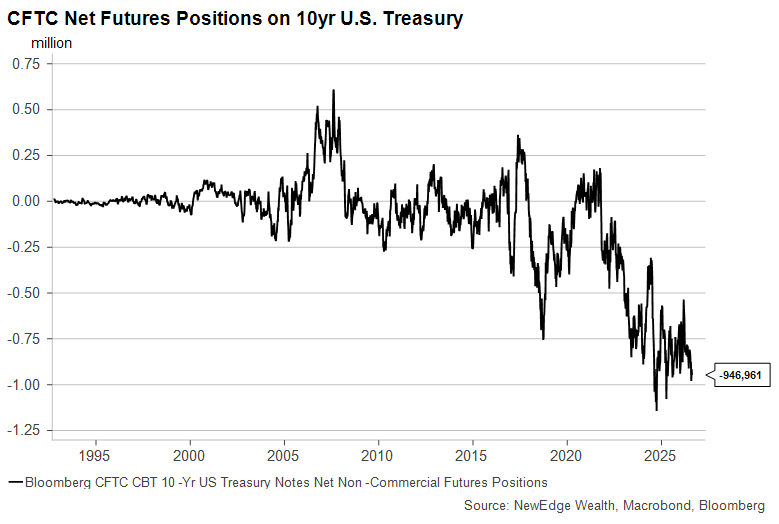
Yields on longer-dated municipal bonds in the 10- to 20-year range look even more attractive, but these bonds carry significant risk of a market loss (though not a default) should rates move higher from here. One thing that ironically makes us comfortable with accepting more duration in portfolios is that everyone seems to think it’s a terrible idea. Investors who stake out futures positions on the 10-year Treasury Note are about as net short as they’ve ever been:
As of 8/28/26
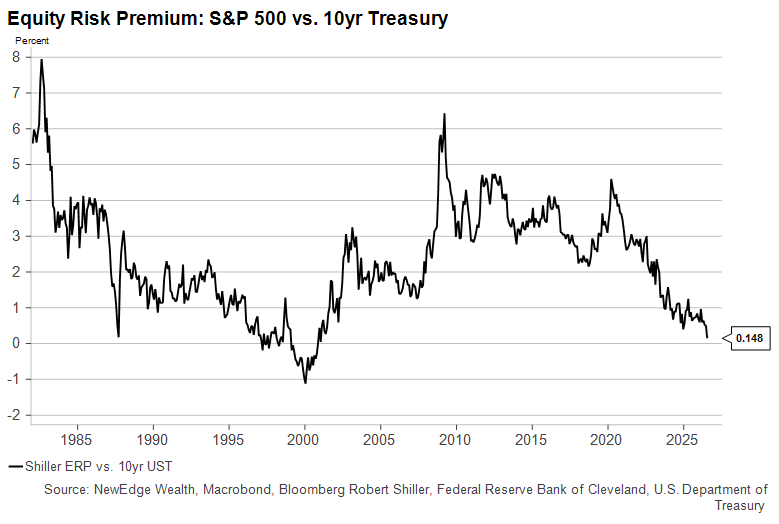
Longer-term investors who rely less on positioning data to make investment decisions can rest easy that relative valuations also point to the best entry point for longer-duration bonds vs. stocks in a generation:
As of 8/28/26
Our enthusiasm for bonds is by no means unbridled. Another string of hot inflation data – more likely given the rise in gasoline and diesel prices in August – could send rates even higher, particularly if the Fed is slow to react to it. And as we wrote above, none of the Treasury’s gambits to influence the yield curve are likely to work even if they pass legal muster.
As Dolly Parton said aptly in the quote above, we cannot direct the wind, but we can adjust the sails. Investors whose allocations have fallen out of balance may be taking too much equity market risk or simply failing to maximize their risk-adjusted income streams by hanging onto too much cash. These strategies made sense when stocks were cheaper and the Treasury yield curve was inverted, but they are not necessarily optimized for an environment in which the curve is steeper and valuations point toward bonds.
IMPORTANT DISCLOSURES
The views and opinions included in these materials belong to their author and do not necessarily reflect the views and opinions of NewEdge Capital Group, LLC.
This information is general in nature and has been prepared solely for informational and educational purposes and does not constitute an offer or a recommendation to buy or sell any particular security or to adopt any specific investment strategy.
NewEdge and its affiliates do not render advice on legal, tax and/or tax accounting matters. You should consult your personal tax and/or legal advisor to learn about any potential tax or other implications that may result from acting on a particular recommendation.
The trademarks and service marks contained herein are the property of their respective owners. Unless otherwise specifically indicated, all information with respect to any third party not affiliated with NewEdge has been provided by, and is the sole responsibility of, such third party and has not been independently verified by NewEdge, its affiliates or any other independent third party. No representation is given with respect to its accuracy or completeness, and such information and opinions may change without notice.
Investing involves risk, including possible loss of principal. Past performance is no guarantee of future results.
Any forward-looking statements or forecasts are based on assumptions and actual results are expected to vary from any such statements or forecasts. No assurance can be given that investment objectives or target returns will be achieved. Future returns may be higher or lower than the estimates presented herein.
An investment cannot be made directly in an index. Indices are unmanaged and have no fees or expenses. You can obtain information about many indices online at a variety of sources including: https://www.sec.gov/answers/indices.htm.
All data is subject to change without notice.
© 2026 NewEdge Capital Group, LLC

