


Introduction: I Thought You Said No More Aches and Pains?
“That wasn’t part of the plan.”
It’s been a little over two months since we wrote (optimistically) about the softer spring and early summer inflation data, and wow, how things have changed! Or have they?
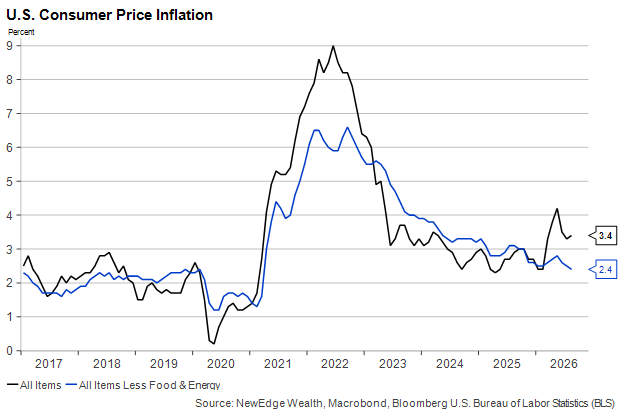
August 2026
We’ll start with a hot take: inflation is not especially high right now. The commodity price shock from the Middle East has interrupted what had been a multi-year period of disinflation. But netting out the energy effects, core CPI inflation eased to 2.4% year-on-year in August. As the graph above shows, investors don’t have to look back too far to recall far steeper price increases. The massive inflationary wave that crashed over the economy in 2022 pushed interest rates higher and real incomes lower. The worst of it faded quickly, but price pressures are still firmer than they were throughout the 2010s, the period most households still anchor to.
The inflationary shock during the earlier part of this decade created lasting trauma in markets, leaving them more prone to misunderstanding and panic. This phenomenon happens to be the central theme of Vertigo, the 1958 Alfred Hitchcock classic widely considered one of the greatest films ever made. Its hero, Scottie Ferguson, played with aplomb by Jimmy Stewart, is haunted by the loss of his lover, Madeline (the legendary Kim Novak), after failing to prevent her from (apparently) plunging to her death. He soon meets a Madeline doppelganger, Judy Barton. The audience knows it’s the same woman, but Scottie doesn’t. Instead, he tries to style Judy to even more closely resemble Madeline, a rather unhealthy way of channeling his grief and guilt, it should be said. Rather than move on and enjoy Judy’s company, Scottie tries to refashion the present to more closely resemble the past…all while battling an acute fear of heights.
Investors who expect the investing landscape in 2026 or 2027 to be a repeat of 2022 may be making the same mistake Scottie did. Unlike Scottie Ferguson’s ill-fated experience with Madeline/Judy, we are not likely to repeat precisely the same experience this year as we did four years ago. Inflation may move higher from here, for reasons we’ll elaborate on in this piece, and the investment environment may feel directionally similar at times. But the magnitude of the moves will, we think, be much smaller.
Why is High Inflation a Risk for Investors?
“If I let you change me, will that do it? If I do what you tell me, will you love me?”
Let’s start by addressing the reasons investors are so sensitive to inflation risks. First, inflation eats away at household income and purchasing power, leading to sharp lasting declines in consumer sentiment. Second, inflation risks ultimately become interest rate risks, either through higher short-term rates (as the central bank tightens) or higher long-term rates (if the central bank is seen as behind the curve).
High gas prices aside, the second risk has become the more concerning one in the second half of 2026. Markets have begun to accept the idea that getting inflation down to 2% will require tighter monetary policy, which means higher interest rates. The Federal Reserve endorsed this view when its open market committee (FOMC) raised rates earlier this month, as we covered last week. This decision, along with a slew of public comments from FOMC members in the week following it, has led investors to raise their expectations for how much tightening the Fed will do in the next year (the current federal funds target rate is 3.875%):

As of 9/25/26
The market is forecasting significantly higher rates than the FOMC itself, which expects to hike rates only once more in this cycle. But we know from history that once a central bank starts to hike rates, it often ends up hiking more than it expects at the outset. How much the Fed tightens will depend on inflation data and bond market behavior. Let’s start with the data.
Inflation is in the Eye of the Beholder
“For a man who has nothing to do, you’re certainly a busy little bee.”
The Fed targets a 2% rate of inflation in the price index for core personal consumption expenditures. That means energy and food don’t enter directly into its thinking, and it also means that producer prices (what businesses charge to other businesses) are only relevant if their changes affect what consumers pay. But even focusing just on Core PCE Inflation can be tricky because of how many ways there are to measure it:

As of August 2026
These metrics have all risen by more than 2% over the past year, but the magnitude of the “miss” determines the dose of tightening needed to remedy it. Leading indicators for inflation matter, as well, and this is where energy costs come into play. Price categories within business sentiment gauges like the ISM Index have been good predictors of future inflation. Service sector businesses are currently reporting sharply higher input costs, which, as this chart shows, they tend to pass onto consumers:
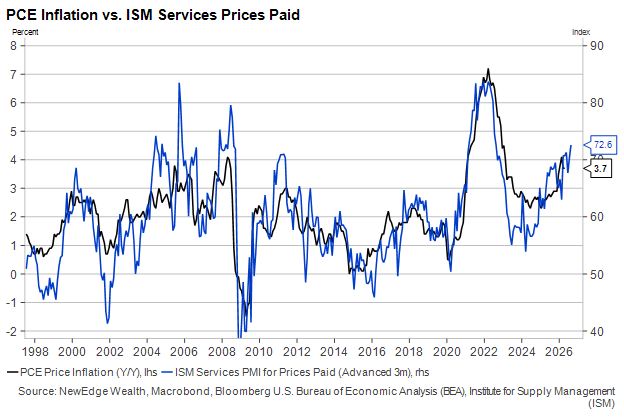
As of 9/25/26
Manufacturers are reporting longer delivery times, implying supply chain bottlenecks are getting worse and the cost of making deliveries is increasing thanks to spiking diesel prices. This could push goods prices higher in the coming months:

As of 9/25/26
Preventing inflation from moving higher – let alone bringing it down – will not be an easy task. First, in the face of high tariffs and diesel costs, goods price inflation seems unlikely to moderate anytime soon. We also know that capital spending related to A.I., while not a direct contributor to consumer price inflation, is driving up the cost of computer chips, batteries and construction materials among other key inputs. And booming A.I. investment is not going to vanish as a result of a few rate hikes.
Second, while housing is not contributing much to overall inflation, its multi-year period of disinflation is likely over. Depressed construction activity and home sales could eventually put upward pressure on rents even if home prices aren’t rising much.
That leaves other core services as the third channel for potential disinflation. This category hinges on the labor market and financial asset prices. We’ll address financial markets in the next section, but the labor market is where we see the biggest difference between 2022 – when the U.S. jobs market was white hot – and 2026.
Falling jobless claims and steady job openings tell us that the labor market is no longer getting worse, as it was throughout 2025. But wage growth is still not sending any inflation impulses into the wider economy. Employment cost growth has been slowing, and unit labor cost growth (the amount firms need to pay workers to generate a unit of output) is subdued:
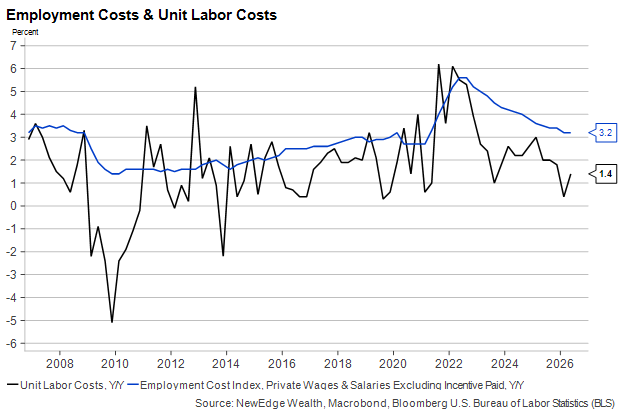
As of Q2 2026
Inflation Risks for Markets
“I warn you, I can yell awfully loud.”
Inflation presents risks to investors in just about every asset class. In 2022, when CPI inflation briefly breached 9%, bonds and stocks sold off together and “long duration” sectors like technology severely underperformed as future earnings were discounted at higher rates. During periods in which inflation risks dominate growth risks, stock and bond prices tend to move in the same direction. In the 2010s, when growth risks were the primary concern, stocks and bonds were negatively correlated:

As of 9/25/26
After briefly reverting to negative correlation in 2025, stocks and bonds have tended to move in the same direction on a week-to-week basis in 2026. Investors rightly see the 1%+ rise in the 10-year U.S. Treasury yield as challenging for high stock market valuations. While the S&P 500 Index is up more than 12% this year, this return is entirely the result of rising earnings growth, which is currently estimated to come in at more than 30% in 2026. As a result, the index’s 12-month forward P/E ratio has fallen from 22.3x in December to below 20x today:
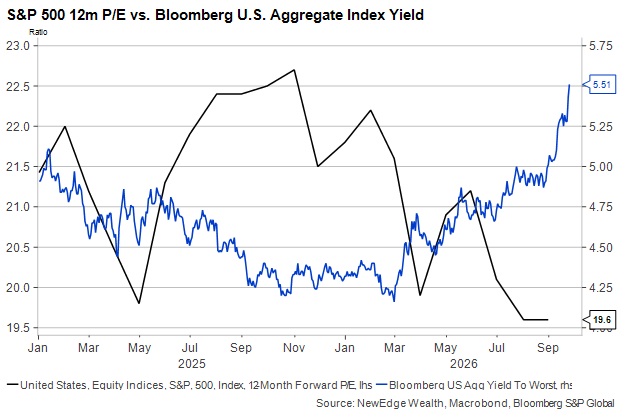
As of 9/25/26
At the same time, at least part of the increase in long-term rates we’ve seen over the past seven months is being driven by concerns that the Fed is behind the curve or soon will be. Higher 10-year and 30-year Treasury yields are the bond market’s way of telling policymakers that inflation and growth are running too hot, and rising 2-year yields are the bond market’s way of telling policymakers that they expect action to slow things down:
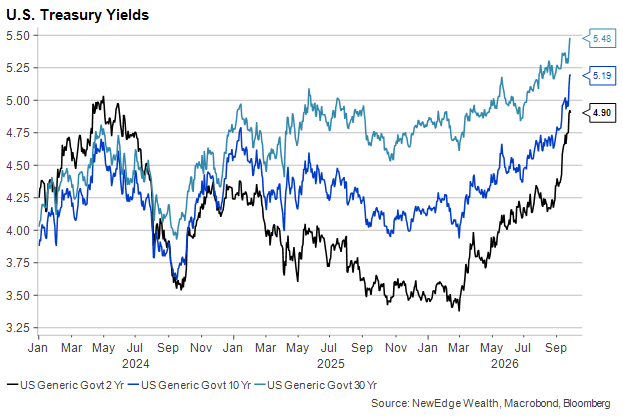
As of 9/25/26
Lastly, inflation and rate moves can influence relative market returns. Throughout this year, returns have broadened within the S&P 500 at times when inflation has come in cooler and narrowed when data has come in hot. Over the past few weeks of sharply rising long-term rates, performance has narrowed considerably to include mainly mega cap technology stocks tied to the A.I. buildout.
To illustrate this point, this final chart shows that the equal-weighted index has sharply underperformed the market-weighted index during two specific periods: the spring period when rate cuts were priced out, and the late summer period when rate hikes were priced in. Cyclical companies dependent on low interest rates to refinance their debt come under particularly high stress during periods of rising rates, while those flush with cash and closely tied to the A.I. story have been relatively immune. This represents an important difference between 2022, when technology stocks underperformed, and 2026, when they’ve been the standouts since rates bottomed in February.
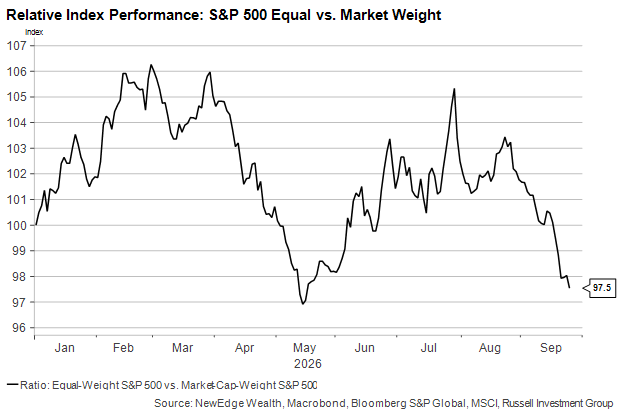
As of 9/25/26
Conclusion
“One final thing I have to do, and then I’ll be free of the past.”
We may remember September 2026 as the month in which the bond market ran out of patience with the Fed and took matters into its own hands. This has led to a selloff in fixed income markets and an aggressive rotation from non-A.I. cyclical stocks into technology. Driving these moves is a view that getting inflation down will require more significant intervention from the Fed.
Even so, we don’t believe inflation will rise to anything approaching its 2022 peak, and we expect diversified portfolios to perform fine in a period of gradually tightening financial conditions. A.I. capex, which continues to drive earnings growth and the equity market, seems unlikely to buckle under the gentle pressure of a few more Fed rate hikes, and the Fed has given no indication that it is willing to inflict significant pain on the economy in the name of bringing inflation down by 1%.
After more than three years of above-average equity market returns, investors may, like Scottie Ferguson, be fearful of falling from a great height. The one-two punch of elevated inflation and a bond market revolt that forces the Fed into a tightening cycle might seem like the perfect catalyst for a plunge. But investors should not lean too heavily on the lessons of 2022 given the higher starting point for rates and the much cooler dynamics in the labor and housing markets. Strong growth, led by consumers and A.I. investment, is driving up interest rates and creating some excess inflation. Whether that inflation needs to be pushed lower or simply kept at bay is a question for policymakers. But we do not think this Fed – or this administration – is about to push us off a cliff.
IMPORTANT DISCLOSURES
The views and opinions included in these materials belong to their author and do not necessarily reflect the views and opinions of NewEdge Capital Group, LLC.
This information is general in nature and has been prepared solely for informational and educational purposes and does not constitute an offer or a recommendation to buy or sell any particular security or to adopt any specific investment strategy.
NewEdge and its affiliates do not render advice on legal, tax and/or tax accounting matters. You should consult your personal tax and/or legal advisor to learn about any potential tax or other implications that may result from acting on a particular recommendation.
The trademarks and service marks contained herein are the property of their respective owners. Unless otherwise specifically indicated, all information with respect to any third party not affiliated with NewEdge has been provided by, and is the sole responsibility of, such third party and has not been independently verified by NewEdge, its affiliates or any other independent third party. No representation is given with respect to its accuracy or completeness, and such information and opinions may change without notice.
Investing involves risk, including possible loss of principal. Past performance is no guarantee of future results.
Any forward-looking statements or forecasts are based on assumptions and actual results are expected to vary from any such statements or forecasts. No assurance can be given that investment objectives or target returns will be achieved. Future returns may be higher or lower than the estimates presented herein.
An investment cannot be made directly in an index. Indices are unmanaged and have no fees or expenses. You can obtain information about many indices online at a variety of sources including: https://www.sec.gov/answers/indices.htm.
All data is subject to change without notice.
© 2026 NewEdge Capital Group, LLC

