


These days I think are so strange
No cuts, no trust
Name no names
“So Far So Fake”, Pierce The Veil
Given the title of this piece, using Pierce the Veil’s 2023 banger “So Far So Fake,” let’s be clear from the start: we are not calling all of the remarkable earnings in 2Q26 “fake,” but we are flagging that a big part of this quarter’s impressive growth is coming from “So Far So Fake” paper gains that are unlikely to repeat, creating “tough comps” for 2027 earnings growth that could challenge current consensus expectations.
We’ll explain.
The second quarter of 2026 earnings season has been extraordinary by all measures.
The pace of growth on a year-over-year basis has been off the charts and has wildly surpassed analyst estimates going into the quarter. 2Q26 Headline EPS for the S&P 500 is tracking at 47.4% vs. 23% expected at the start of reporting season. The two charts below show how much earnings estimates have jumped as we have progressed through the quarter, and how positive revisions to EPS estimates have only been larger one other time since 2006.
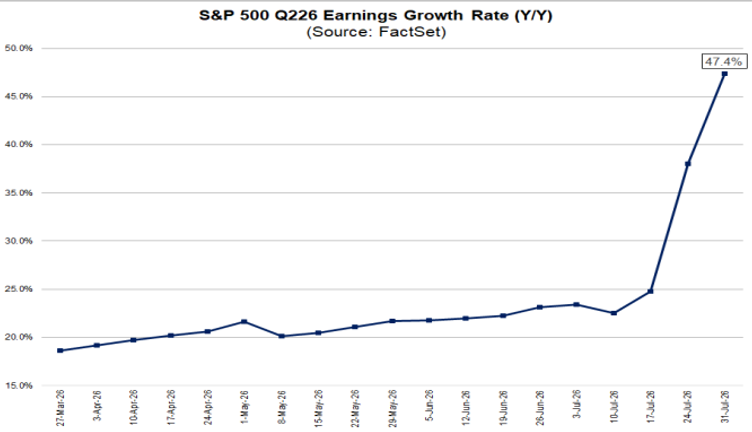
Source: FactSet, as of 7-31-26
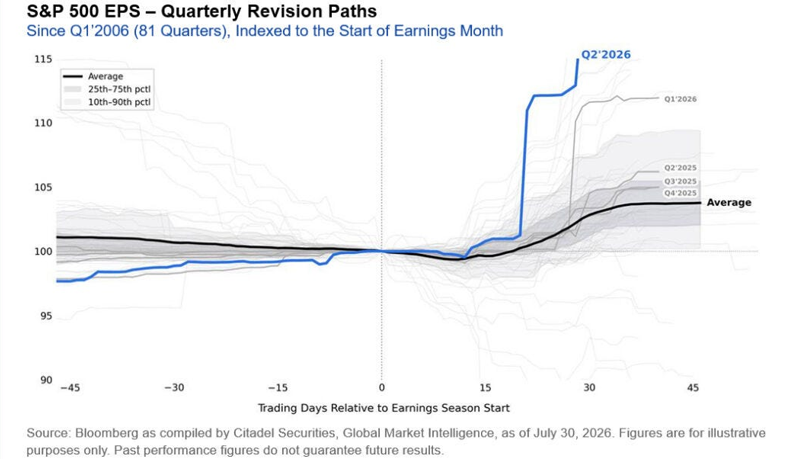
Source: FactSet, as of 7-31-26
As seen below, this headline 47.4% EPS growth is the fastest pace of growth since 2Q21, when earnings were rebounding from the COVID reopening trade.
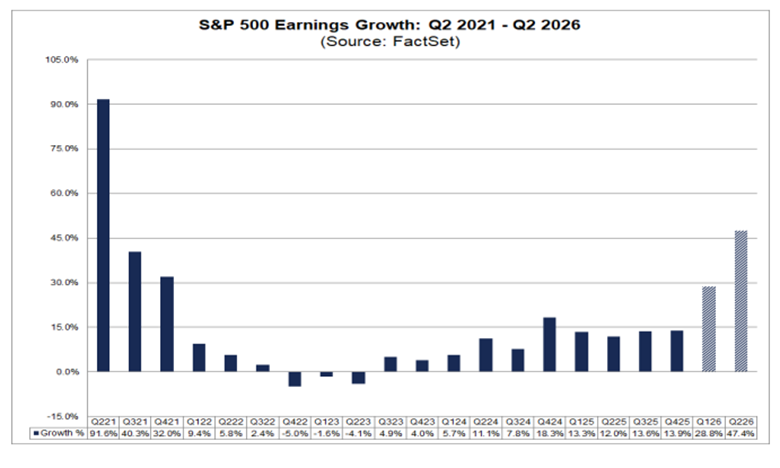
Source: FactSet, as of 7-31-26
Before we start listing off all of the caveats that are needed when looking at this eye-popping, nearly-50% headline growth number, we have to acknowledge that there is a healthy breadth to how earnings are beating expectations. The next chart shows how the current beat rate of 88% (meaning 88% of companies are beating sell-side consensus estimates) is at a record high and well above the long-term average.
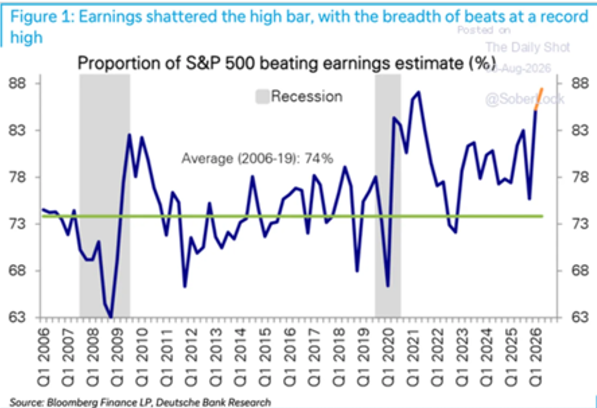
As of 8-5-26
Further, a robust level of beats is happening across sectors, which is important to flag as we talk about the ultra-dominance of tech/Mag 7 within the absolute earnings growth levels.
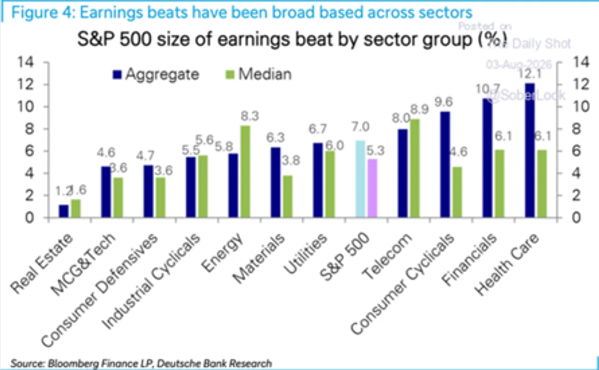
As of 8-5-26
We must note that the source of this broad based strength in earnings is thanks in part to strong nominal economic growth in the quarter as well. The chart below shows the acceleration in nominal GDP in 2Q26 to 6.5% YoY (or growing at an 8.1% annualized rate). Though this nominal GDP acceleration (black line) was driven by higher inflation, not higher real growth (blue line), the translation to earnings is that earnings are a nominal calculation, so earnings growth benefits from rising prices/inflation.
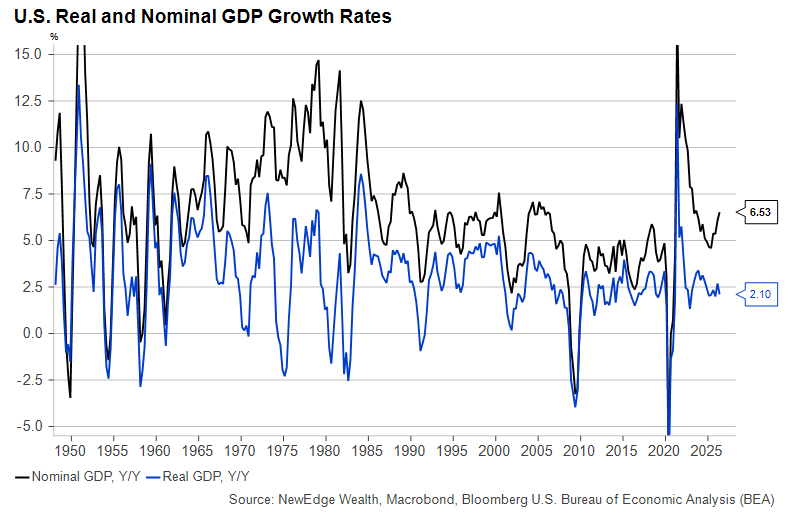
As of 8-6-26
So the summary thus far is: 2Q26 has delivered incredibly strong headline earnings growth, with robust breadth across sectors supported by a resilient U.S. economy. However (and this is an emphatic however!), now we have to introduce our caveats.
“The Head Is Only a Dangerous Dead Weight”: The Caveat of One-Time Gains
The first and second quarters of 2026 have benefitted from unusually large non-operating, unrealized gains on investments at both Alphabet (GOOG/GOOGL) and Amazon (AMZN).
These gains are so big that if you remove the impact from these paper profits, the YoY earnings growth for 2Q26 falls from 47% to 28% (28% is still a very impressive growth rate, given we are not emerging from a downturn).
It is helpful for us to take some time to understand what these gains are in order to better anticipate how earnings could progress in the coming quarters (buckle up for some basic financial accounting, but it will be worth it!).
Both Alphabet and Amazon have large investments in companies that have seen significant valuation increases in the 1H of 2026.
Both Alphabet and Amazon have investments in Anthropic, which had its valuation vault from $183B at the end of 2025, to $380B in 1Q26, and $965B in 2Q26 as it raised incremental rounds of capital. Alphabet has an investment in SpaceX (SPCX), which had its valuation launch from $800B at the end of 2025, to $1.25T in 1Q26, to an IPO valuation of $1.77T at its IPO in 2Q26.
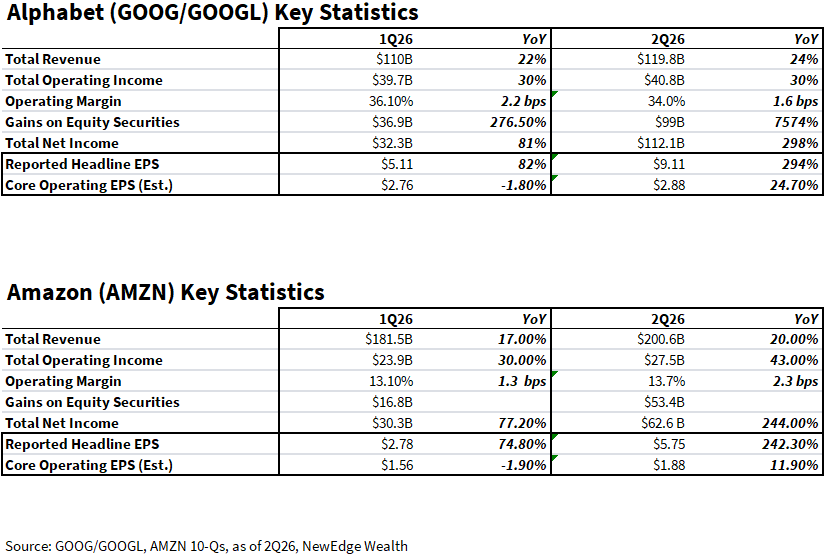
Without getting too technical, these changes in valuation for Anthropic and SpaceX get reflected as non-operating, unrealized (because the companies didn’t actually sell any shares) gains on the income statement. And these gains have been HUGE.
The tables below show key statistics from 1Q26 and 2Q26 for Alphabet and Amazon that illustrate these gargantuan gains. As an example, Alphabet reported $9.11 of earnings in 2Q26, up nearly 300% YoY, but only $2.88 of that earnings came from its operations (which was up a more modest 30%). The rest of Alphabet’s earnings, or $6.23) came from gains on investments, primarily Anthropic and SpaceX. You can see a similar dynamic with Amazon.
We are already starting to see how fleeting these paper gains can be, as we see the valuation of SPCX plunge in public trading. SPCX is down over 40% since the end of June, so if this valuation were to persist through the rest of this quarter, Alphabet would have to record a mark-to-market loss on its position.
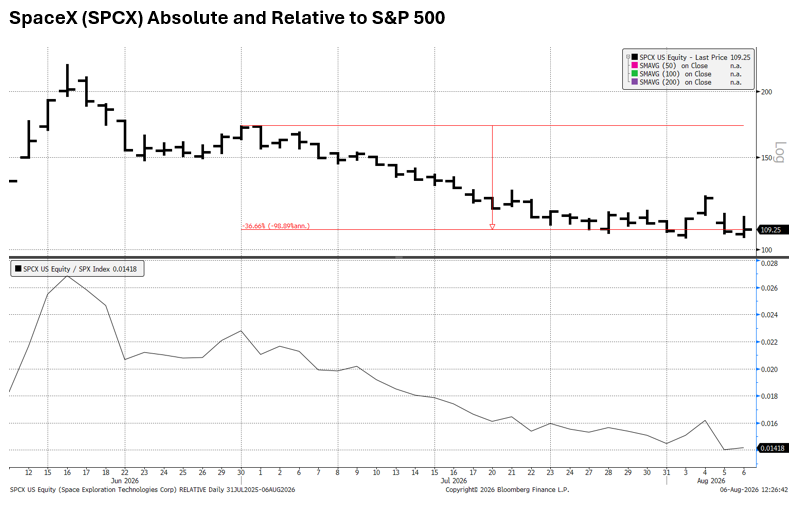
Source: Bloomberg, NewEdge Wealth, 8-6-26
Further, in order for more gains to be recognized on an investment like Anthropic, the AI company would have to raise incremental capital either through private markets or an IPO. If Anthropic does not raise capital in 3Q, for example, then neither Alphabet nor Amazon will recognize gains for the current quarter.
As we look to 2027, we do not think it is likely that we will see the magnitude of gains repeat, which means that the reported GAAP EPS for Alphabet and Amazon have the potential to decline in 1Q and 2Q 2027.
Given how much these gains have boosted total S&P 500 earnings (remember 2Q26 earnings would be 20 percentage points lower without the gains!), these gains are likely to act as a Pierce the Veil-esque “dangerous dead weight” for 2027 growth statistics.
Interestingly, top-down analysts do not seem too concerned (or aware?) that a large chunk of 1Q and 2Q 2026 earnings are unlikely to repeat in 2027. The chart below of technicolor spaghetti shows, for example, how 1Q27 estimates of $94.58 are well above 1Q26 of $80.69 that include these significant gains (estimated to be ~$6 of EPS in 1Q26). When stripping out the gain, the implied growth rate for 1Q next year jumps from a fulsome 17% to an aggressive 27%. As we are learning in 2026, “never say never” when it comes to supernormal earnings growth, but this estimate sure does set a high bar to kick off next year.

Source: Bloomberg, NewEdge Wealth, 8-6-26
The high bar for 1Q27 raises the question as to whether or not there is much upside left to the 2027 full year earnings estimate, which now sits at $405/share, or +13% growth on top of 2026’s stellar 30% growth. As we near 2027, the equity market is likely to be come increasingly sensitive to changes in these forward earnings estimates, meaning downward pressure on 2027 earnings could usher in more volatility, while upward revisions would support continued price gains.
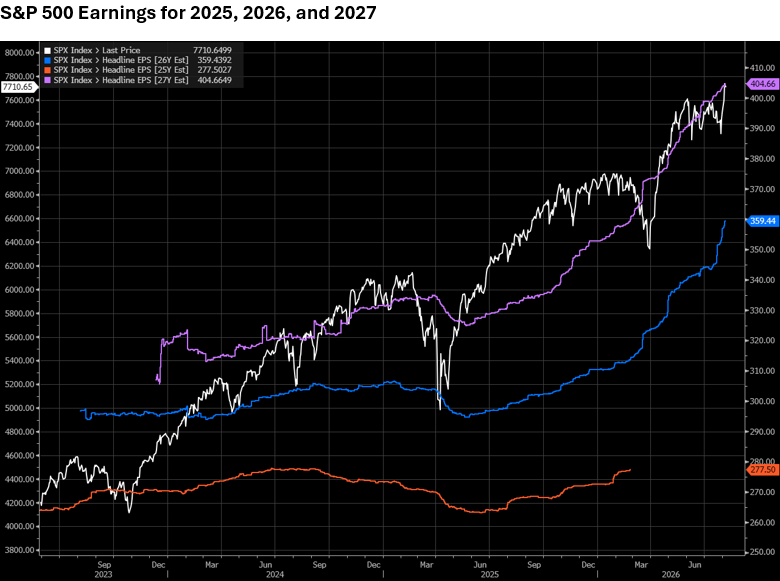
Source: Bloomberg, NewEdge Wealth, 8-6-26
“Just Like Brain Freeze You’ll Fade”: Can Memory Remain a Huge Driver of EPS?
No discussion about the prospects for 2027 earnings growth over 2026’s stellar numbers would be complete without acknowledging the massive contribution that memory stock earnings are making to overall S&P 500 earnings this year. The chart from FactSet below shows how Micron (MU) not only is the largest contributor to S&P 500 earnings in 2Q, but its $25 contribution is nearly 25% of total S&P 500 earnings for the quarter.
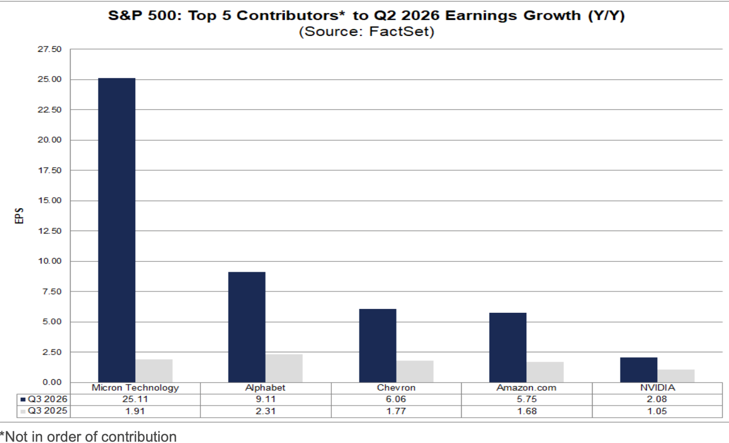
Source: FactSet, as of 7-31-26
Given the industry expects a continued shortage of memory supply compared to ravenous AI demand, MU is expected to double earnings again in 2027, but this 100% growth rate is a meaningful deceleration from 2026’s expected 850% (not a typo!) growth.
Of course, as we wrote about in a recent Weekly Edge, the continuation of this memory and tech infrastructure cycle is highly dependent on the hyperscalers’ willingness and ability to spend aggressively on physical AI infrastructure. Thanks to negative free cash flow (meaning hyperscalers in aggregate are set to spend more on capex than their operating cash flows in 2027), hyperscaler’s ability to spend is partially dependent on debt and equity markets that are helping to fund this spend (for now, capital markets appear wide open for funding hyperscaler investments, but at an increasingly higher price).
It is not just the external financing that is important to consider, it is the circular financing that must be appreciated. Consider these statistics in light of last week’s news that NVDA is considering a $250B backstop of OpenAI’s infrastructure spending: OpenAI makes up 40% of MSFT’s cloud backlog and currently accounts for 70% of MSFT’s AI revenue, while MSFT is 22% of NVDA’s revenue and NVDA is 17% of MU’s revenue.
All of this is to say that a key real operating (not like those “so far so fake” paper gains) reason why S&P 500 earnings have been able to deliver such powerful growth in 2026 has been the ultra-powerful memory trade. Memory remains a highly cyclical, highly competitive industry, so a deceleration in AI capex spend (of which we are seeing no evidence of at this time), would result in amplified downside in these earnings.
“In the End You Took it All Away From Me”: Circular Conclusion
Overall, even if we remove the one-time gains from 1Q and 2Q 2027 earnings, the underlying operating earnings growth rate remains highly impressive. There has been breadth to these earnings, helped by nominal GDP, but the dominant driver of large upside to estimates has been the “So Far So Fake” paper gains from Alphabet and Amazon and the memory super cycle.
These are all important features to appreciate as we think about the prospects for 2027 growth, on which the market will grow increasingly focused as this year enters its final months.
The “So Far So Fake” one-time gains plus the memory earnings surge in 2026 do create notably tough comparisons for 2027, and arguably could be seen as an period of “over earning”, where today’s high growth sets up for weaker growth in the future.
For now, 2026 and 2027 estimates continue to climb higher, giving no signal that there is any concern about over earning, unsustainable growth, or tough comparisons this year or next. The resilience of the U.S. economy is a supportive factor for this optimism, but arguably it is the continuation of the external and circular financing of the AI infrastructure boom that will matter far more.
IMPORTANT DISCLOSURES
The views and opinions included in these materials belong to their author and do not necessarily reflect the views and opinions of NewEdge Capital Group, LLC.
This information is general in nature and has been prepared solely for informational and educational purposes and does not constitute an offer or a recommendation to buy or sell any particular security or to adopt any specific investment strategy.
NewEdge and its affiliates do not render advice on legal, tax and/or tax accounting matters. You should consult your personal tax and/or legal advisor to learn about any potential tax or other implications that may result from acting on a particular recommendation.
The trademarks and service marks contained herein are the property of their respective owners. Unless otherwise specifically indicated, all information with respect to any third party not affiliated with NewEdge has been provided by, and is the sole responsibility of, such third party and has not been independently verified by NewEdge, its affiliates or any other independent third party. No representation is given with respect to its accuracy or completeness, and such information and opinions may change without notice.
Investing involves risk, including possible loss of principal. Past performance is no guarantee of future results.
Any forward-looking statements or forecasts are based on assumptions and actual results are expected to vary from any such statements or forecasts. No assurance can be given that investment objectives or target returns will be achieved. Future returns may be higher or lower than the estimates presented herein.
An investment cannot be made directly in an index. Indices are unmanaged and have no fees or expenses. You can obtain information about many indices online at a variety of sources including: https://www.sec.gov/answers/indices.htm.
All data is subject to change without notice.
© 2026 NewEdge Capital Group, LLC

