


Like a bad star, I’m falling faster down to her
She’s the only one who knows what it is to burn
“What It Is to Burn”, Finch
In a podcast recording on Thursday, we shared that Google’s 2Q earnings reminded us of that great Deftones song “Change (In the House of Flies)”, where Chino Moreno’s breathy growls of “I watched you change…” are an apt reaction to the changing business models and financials of hyperscalers spending aggressively on AI capex (for AI capex and hyperscaler background see our recent pieces here and here).
So, it is fitting that this week’s Weekly Edge song inspiration comes from a band that actually began as a Deftones cover band. Finch got its start in Temecula, California, when the only songs the band knew how to play together were Deftones covers.
Finch’s greatest hit is a soaring post-hardcore screamo song called “What It Is to Burn”, where singer Nate Barcalow cries out, “she’s the only one who knows what it is to burn.” But given this song was released in 2001, Finch could not have known that this “she” would not be the only one who “knows what it is to burn,” as hyperscalers are proving that, when it comes to free cash flow, they certainly “know what it is to burn.”
The sheer incineration of free cash flow generation at the hyperscalers has been one of the most important market stories of the past year. The chart below shows the epic “wealth transfer” from hyperscalers spending on AI capex to semiconductor companies who have been receiving many of these capex dollars.
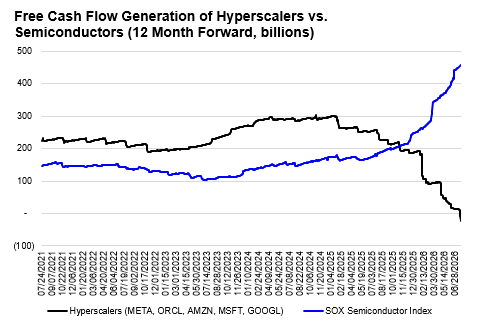
Source: Bloomberg, NewEdge Wealth, as of 7-24-26
This story has been well captured by stock prices, as seen in the stark divergence in performance over the last year of the companies spending capex dollars (hyperscalers) and those receiving the capex dollars (semiconductors).
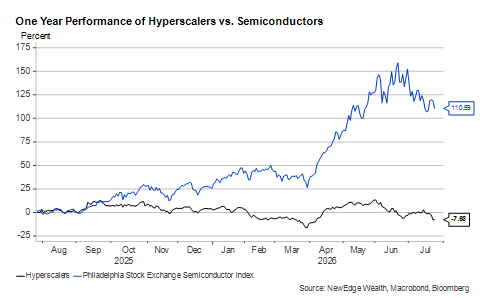
As of 7-24-26
And based on Alphabet/Google’s 2Q26 earnings release this week, there appears to be no near-term end in sight to this aggressive capex and thus weak free cash flow generation. Note, free cash flow is calculated by subtracting capex from Cash Flow from Operations, a measure that removes the “non-cash” adjustments to Earnings Per Share (such as the $98B paper gain that Google recognized on its SpaceX and Anthropic positions in 2Q26). The company raised its full-year guidance for capex in 2026 and said capex would “increase significantly” in 2027.
And it is not just GOOGL that is expected to deliver a significant increase in spending; all the hyperscalers are expected to “kick it up a notch” (an ode to the Emeril memes making the rounds recently), with total hyperscaler capex expected to jump further in 2027.
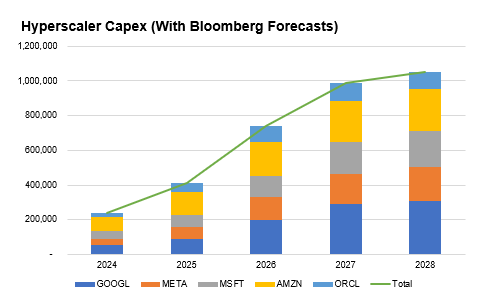
Source: Bloomberg, NewEdge Wealth, as of 7-24-26
Many analysts such as at Goldman, Morgan Stanley, and JP Morgan have been flagging that capex forecasts have been too low in the last year (see the JP Morgan chart below that flags that hyperscaler capex forecasts for 2026 are +100% vs. this time last year), so they see further upside to 2027 capex estimates (Morgan Stanley recently called for capex to reach $1.2T in 2027 and $1.4T in 2028).
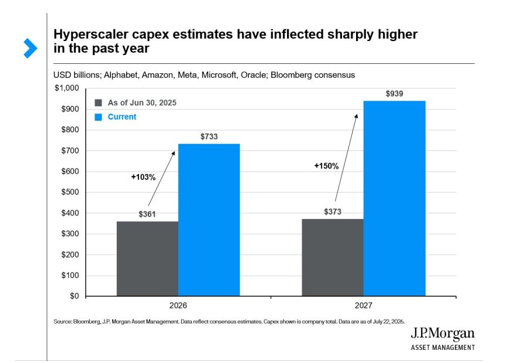
As of 7-22-26
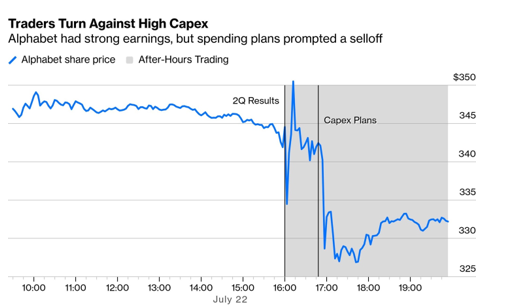
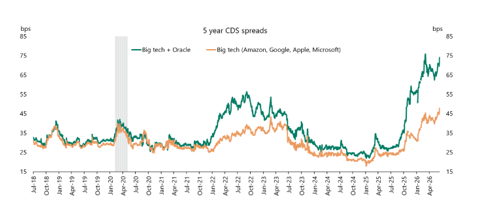
Taking it back to this week, Google’s stock reacted poorly to this higher capex commentary, as shown by Bloomberg’s John Authers chart below, which brings back a key question that we highlighted in our recent Nine Inch Nails themed piece: how long can hyperscalers continue to spend aggressively on AI capex if both equity and credit markets (see the Apollo chart below) are souring in their perception of and willingness to fund this spending, all the while their own ability to self-fund through cash generation is depleted?
Source: Bloomberg
Source: Apollo, as of 7-11-26
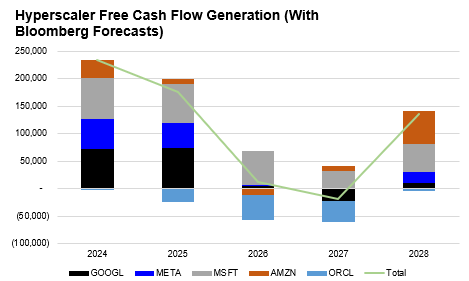
Based on current consensus forecasts, the Street expects overall hyperscaler free cash flow generation to go negative in 2027 (meaning the Street is expecting hyperscalers to spend more on capex than they are earning in operating cash in the year). This means that hyperscalers will have to spend more cash off their balance sheets and/or raise incremental debt and equity to fund the $1T+ of 2027 capex. But we repeat, with the cost of the debt and equity going up (spreads widening and stock prices falling), the “price to pay for glory” (to use a Finch line) could become an increasing challenge to these capex plans.
Source: Bloomberg, NewEdge Wealth, as of 7-24-26
Importantly, the chart above shows how the Street is sanguine on free cash flow improving in 2028, even as capex continues to rise, as analysts expect the payoff of all this capex to start outpacing the growth in capex. This forecast for improving FCF relies on the assumption AI-related revenues will grow faster than the cost to serve that revenue, a point that AI bears like Ed Zitron have been heartily refuting.
There is clearly profit and growth being generated by some of this AI capex, but we think it is also clear that the capital-light, low marginal cost legacy business models of the hyperscalers have changed in this highly competitive, capital-intensive AI world. Said another way, the hyperscalers used to be able to make a lot of money without having to spend a lot of money (thanks to their near-monopoly dominance in their legacy business), but now they are having to spend a lot of money in order to drive incremental growth. Higher spending to drive growth suggests lower margins (Google guided to this in 2Q26 within their Cloud business) and lower Return on Invested Capital (ROIC). We have been arguing for the past year that AI would gradually make these hyperscalers lower ROIC companies as we “watch them change” from capital-light monopolies to capital-intensive competitive businesses.
So what does this all mean for broader markets?
First, the five hyperscalers represent a 16% weight in the S&P 500, while it is these companies’ willingness and ability to spend that drives the fate of the AI infrastructure cohort, with semiconductors representing a 19% weight in the S&P 500.
If hyperscalers were to lower expected capex plans, we could see the stocks rally on renewed capital discipline (we say could because if the perception is that lowering capex means lowering growth prospects, then the stocks could come under pressure), while semiconductors would likely sell off on fears that earnings are at or near a peak as hyperscaler capex slows.
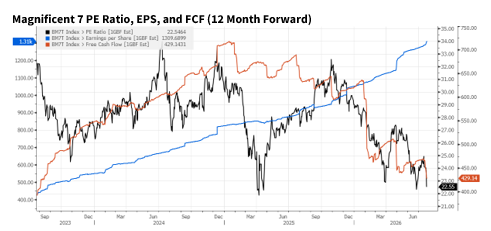
Further, we must note that the deterioration in cash generation is likely a big reason why we have seen valuations for the Mag 7 (which contains the hyperscalers except for ORCL) fall. The chart below shows how valuations for the Mag 7 have fallen to 22x from a peak of 32x back in October of 2025. Mag 7 earnings have continued to soar higher (thanks to one-time gains and accounting assumptions that let these companies spread out the cost of all this capex), but analysts have ascribed a lower valuation to these earnings thanks to the poor cash generation. Falling Mag 7 valuations is one reason why the broader S&P 500 has seen its valuation fall from 23x at its October 2025 peak to 19.5x today.
Source: Bloomberg, NewEdge Wealth, as of 7-24-26
There is no doubt that AI is an exciting technology that is early in its adoption curve and has the potential to significantly alter the way we work in the future (we talk about how being early in an adoption curve does not mean being early in an investment curve in the Deftones-themed podcast). But in the present, we can see the Finch-inspired “price to pay for AI glory” is a significant cash flow burn at hyperscalers and likely a long-term shift in the profitability of their now capital-intensive business models.
IMPORTANT DISCLOSURES
The views and opinions included in these materials belong to their author and do not necessarily reflect the views and opinions of NewEdge Capital Group, LLC.
This information is general in nature and has been prepared solely for informational and educational purposes and does not constitute an offer or a recommendation to buy or sell any particular security or to adopt any specific investment strategy.
NewEdge and its affiliates do not render advice on legal, tax and/or tax accounting matters. You should consult your personal tax and/or legal advisor to learn about any potential tax or other implications that may result from acting on a particular recommendation.
The trademarks and service marks contained herein are the property of their respective owners. Unless otherwise specifically indicated, all information with respect to any third party not affiliated with NewEdge has been provided by, and is the sole responsibility of, such third party and has not been independently verified by NewEdge, its affiliates or any other independent third party. No representation is given with respect to its accuracy or completeness, and such information and opinions may change without notice.
Investing involves risk, including possible loss of principal. Past performance is no guarantee of future results.
Any forward-looking statements or forecasts are based on assumptions and actual results are expected to vary from any such statements or forecasts. No assurance can be given that investment objectives or target returns will be achieved. Future returns may be higher or lower than the estimates presented herein.
An investment cannot be made directly in an index. Indices are unmanaged and have no fees or expenses. You can obtain information about many indices online at a variety of sources including: https://www.sec.gov/answers/indices.htm.
All data is subject to change without notice.
© 2026 NewEdge Capital Group, LLC

