


You’re simply the best
Better than all the rest
Better than anyone
Anyone I’ve ever met
“The Best”, Tina Turner
Tina Turner wasn’t the first artist to record the late 1980s hit “The Best” (Wales’ Bonnie Tyler was the first), but the undisputed “Queen of Rock ‘n’ Roll” was the artist who drove the song to anthem status. From Formula One to Australian rugby to Toyota mini-vans to a region of Northeast England, Tina Turner’s “The Best” has been used as a universal soundtrack for victory, excellence, and achievement.
There’s another entity that can indisputably use “The Best” as its anthem of superior success, and that is, of course, U.S. corporate earnings in 2026.
We have written extensively this year about the strength of S&P 500 earnings and why this earnings strength has allowed the S&P 500 index to shake off (with a similar gusto as Tina Turner’s sequin-fringed shimmying) significant macro headwinds like higher oil prices, stickier inflation, a more hawkish Fed, and soaring bond yields.
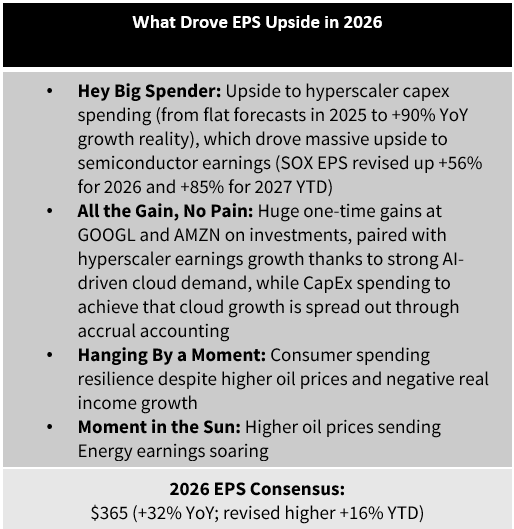
Had we not had the backdrop of constant positive earnings revisions (both 2026 and 2027 S&P 500 EPS estimates have been revised higher by +16% YTD) and powerful absolute YoY growth (2026 EPS estimated growth is +32%), these macro headwinds would have likely had far more impact on markets.
This is not to say that these macro factors have not mattered for markets. Macro has had a huge impact under the surface of strong headline indices as captured by poor breadth statistics (only 23% of the S&P 500 is above its 50 day moving average, a very low reading given the index is less than 1% from an all-time high), narrow sector leadership (only Energy and Tech have positive relative performance vs. the index in 2026), and a S&P 500 valuation that has fallen all year (likely due to higher rates and the market pricing in peak earnings growth).
This raises the important observation that, unlike in prior (or “normal”) cycles, macro factors have not dented the outlook for index earnings this year. Unlike a year like 2022, when higher rates, a tighter Fed, and an energy price shock pushed analysts to cut earnings forward estimates, 2026 has seen analysts have to chase earnings estimates higher all year long.
The table below outlines the key sources of 2026’s earnings upside:
Source: NewEdge Wealth, Bloomberg, as of 10-2-26
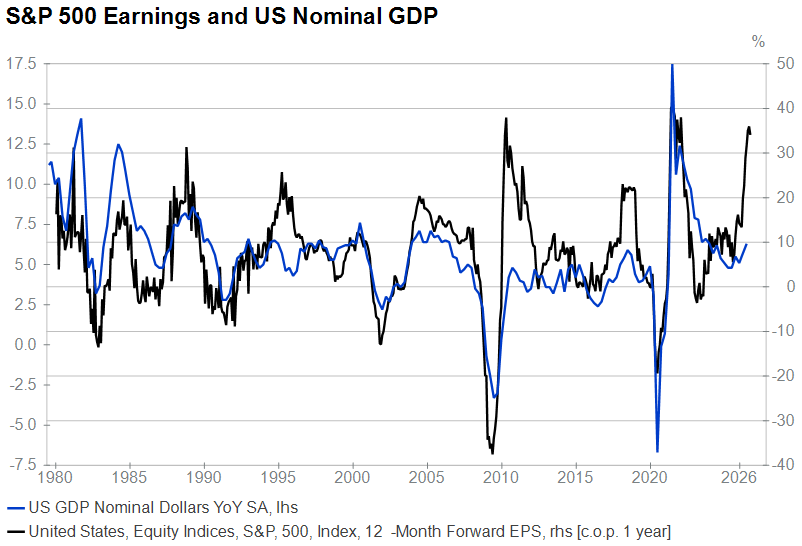
As we hinted at above when talking about falling S&P 500 valuations, the market is rightly appreciating that 2026’s ultra-powerful earnings growth is very likely at a peak. The 32% 2026 growth rate and 36% 12 month forward earnings growth rate is as extraordinary as it is unsustainable.
This does not mean that earnings are set to outright fall in 2027, but that the earnings growth rate is set to moderate substantially. Consensus expects the 2027 EPS growth rate to be cut in half to 14% next year.
We think this slowing growth rate is one reason why, in addition to soaring bond yields, the S&P 500’s valuation has fallen from 23x last October, anticipating this strong earnings, to 19x this October, anticipating slower growth. Equity markets are very good at sniffing out “second derivative” changes, meaning as the growth rate looks to accelerate, multiples expand, and as the growth rate looks to decelerate, multiples contract.
Importantly, this sniffing-out ability is also why the best equity returns often come before the data/earnings come in strong, with ultra-strong data/earnings often being a harbinger of lower returns to come because there is no room for improvement. Effectively, once data/earnings are able to start singing Tina Turner’s “The Best”, forward returns could begin to moderate (which is likely one factor in the market’s meager 1% return over the last four months).
We also must appreciate that today’s ultra-powerful growth rate is running well above what nominal GDP growth would imply, as shown in the chart below and as described by all of the AI-boosted idiosyncratic factors in the table above.
Source: NewEdge Wealth, Bloomberg, as of 10-2-26
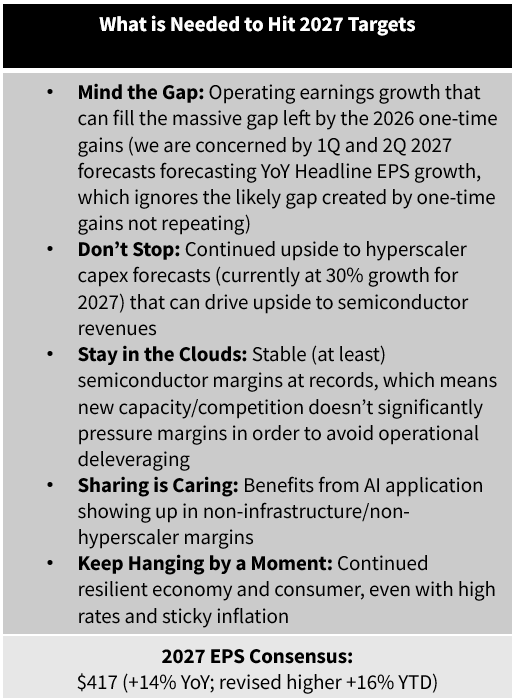
With just three more months of 2026, we must turn our eyes to 2027. As we noted above, the Street is expecting a reasonable slow down in EPS growth from 32% in 2026 to 14% in 2027, but as this 2027 EPS estimate continues to rise (now at $417), we must ask if there is a similar reasonableness to this estimate and what could drive further upside.
The table below outlines the most important considerations for 2027 EPS targets:
Source: NewEdge Wealth, Bloomberg, as of 10-2-26
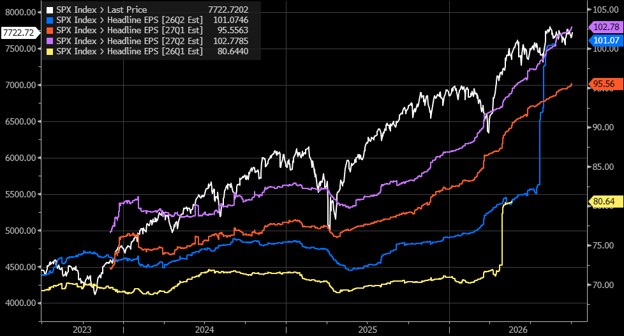
To provide further context for the “Mind the Gap” point above, consider the chart below that shows 1Q and 2Q estimates for 2026 and 2027. Recall that 1Q and 2Q benefited massively from one-time gains at GOOGL and AMZN, so as the Street is expecting higher earnings in both 1Q and 2Q 2027, analysts are implying that this gap from one-time gains will be filled and then some by an improvement in other companies’ earnings.
S&P 500 Earnings in 1Q and 2Q of 2026 and 2027
Source: NewEdge Wealth, Bloomberg, as of 10-2-26
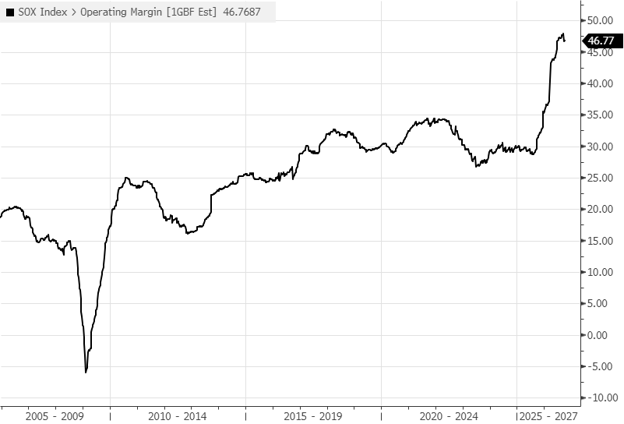
And for further context on the “Stay in the Clouds” point above, the chart below shows how unprecedented the jump in semiconductor industry margin estimates has been over the last year. With the Street expecting semiconductor margins to expand further in 2027 (and given semis’ 18% weight in the S&P 500), this may be the single most important accounting line item to watch next year.
Semiconductor 12 Month Forward Operating Margins
Source: NewEdge Wealth, Bloomberg, as of 10-2-26
“Give Me a Lifetime of Promises and a World of Dreams”: Conclusion
One of our core assertions over the last three years has been that as long as 12-month forward earnings estimates can make all-time highs, the S&P 500 could make all-time highs as well. This core thesis has led us to see potential for volatility, but view that potential volatility with fundamental optimism (a fancy way of saying “buying opportunity”).
The ultra-strong earnings backdrop of 2026 has certainly endorsed this assertion, as it has illuminated how the equity market could be so resilient in the face of major macro headwinds.
This does not mean that we can grow complacent about the earnings outlook for 2027, as even the moderating growth outlook includes some bold assumptions about filling the gap from one-time gains and margins climbing to yet another new record. Though our other core assertion has been “never bet against the great American might of margin expansion”, we are well aware that the recent jump in margins is primarily thanks to a small cohort of semiconductor names that will eventually face margin pressure.
The next test for earnings begins in just two short weeks with 3Q26 earnings season, so let’s see if we can keep blaring Tina Turner’s superlative anthem.
IMPORTANT DISCLOSURES
The views and opinions included in these materials belong to their author and do not necessarily reflect the views and opinions of NewEdge Capital Group, LLC.
This information is general in nature and has been prepared solely for informational and educational purposes and does not constitute an offer or a recommendation to buy or sell any particular security or to adopt any specific investment strategy.
NewEdge and its affiliates do not render advice on legal, tax and/or tax accounting matters. You should consult your personal tax and/or legal advisor to learn about any potential tax or other implications that may result from acting on a particular recommendation.
The trademarks and service marks contained herein are the property of their respective owners. Unless otherwise specifically indicated, all information with respect to any third party not affiliated with NewEdge has been provided by, and is the sole responsibility of, such third party and has not been independently verified by NewEdge, its affiliates or any other independent third party. No representation is given with respect to its accuracy or completeness, and such information and opinions may change without notice.
Investing involves risk, including possible loss of principal. Past performance is no guarantee of future results.
Any forward-looking statements or forecasts are based on assumptions and actual results are expected to vary from any such statements or forecasts. No assurance can be given that investment objectives or target returns will be achieved. Future returns may be higher or lower than the estimates presented herein.
An investment cannot be made directly in an index. Indices are unmanaged and have no fees or expenses. You can obtain information about many indices online at a variety of sources including: https://www.sec.gov/answers/indices.htm.
All data is subject to change without notice.
© 2026 NewEdge Capital Group, LLC

